|
|
| |
 - Endorsed - Endorsed - Indifferent - Indifferent - Contested - Contested
|
| |
| The Nashville Statement
|
| |
|
|
| |
 Name:Daniel
Home: Winnipeg, Manitoba, Canada
About Me: I used to believe that evolution was reasonable, that homosexuality was genetic, and that people became Christians because they couldn't deal with the 'reality' that this life was all there was. I used to believe, that if there was a heaven - I could get there by being good - and I used to think I was more or less a good person. I was wrong on all counts. One day I finally had my eyes opened and I saw that I was not going to go to heaven, but that I was certainly going to suffer the wrath of God for all my sin. I saw myself as a treasonous rebel at heart - I hated God for creating me just to send me to Hell - and I was wretched beyond my own comprehension. Into this spiritual vacuum Jesus Christ came and he opened my understanding - delivering me from God's wrath into God's grace. I was "saved" as an adult, and now my life is hid in Christ. I am by no means sinless, but by God's grace I am a repenting believer - a born again Christian.
My complete profile...
|
| |
Daniel's posts are almost always pastoral and God centered. I appreciate and am challenged by them frequently. He has a great sense of humor as well.
- Marc Heinrich
His posts are either funny or challenging. He is very friendly and nice.
- Rose Cole
[He has] good posts, both the serious like this one, and the humorous like yesterday. [He is] the reason that I have restrained myself from making Canadian jokes in my posts.
- C-Train
This post contains nothing that is of any use to me. What were you thinking? Anyway, it's probably the best I've read all day.
- David Kjos
Daniel, nicely done and much more original than Frank the Turk.
- Jonathan Moorhead
There are some people who are smart, deep, or funny. There are not very many people that are all 3. Daniel is one of those people. His opinion, insight and humor have kept me coming back to his blog since I first visited earlier this year.
- Carla Rolfe
|
| |
|
email
|
|
| No Bravery Without Fear... |
Daddy, what can I do when I don't want to obey you because I am afraid?
You've probably had to explain to your own little ones that unless one is afraid of something, one cannot act in bravery. I mean, every person knows fear (or should) but what makes a person brave is that they do not let their fear control their actions.
When my five year old is afraid of the dark, and because of this fear refuses to go to bed, we sit down and have "the talk". I explain first that there is nothing in the dark to fear, and that this fear is therefore unfounded; but because such information has never pacified a single five year old in the history of mankind, I am inclined to move onto step two, where I explain that in order to be brave you need fear, and that it is time for bravery in the face of this fear. etc.
My post isn't about parenting or fear, or bravery for that matter, but I believe understanding these things will help one to understand the metaphor I plan to use in the following spiritual encouragement.
What do I do, when I don't want to obey God?
Here is where the fear/bravery thing comes into play. If bravery requires fear, we might also say that obedience to God (when sinners are inclined against obedience) requires one to overcome self. Now before we get too far on that road, let me say right now that no one in their own strength can truly overcome self. We need, as Paul taught, to reckon our "self" as dead to sin, but alive to God.
The lesson isn't that in order to obey, you first need an inclination to disobedience, and thereafter you must "buck up" in your own strength, and this bucking up shares some sort of kinship with bravery. Rather the lesson is that in order for you to obey you must overcome the flesh in Christ.
That might sound like just a trite Christian phrase, "overcome the flesh in Christ". I bet some of you reading will say to yourself as you read that, "If I knew how to overcome the flesh in Christ, I would be doing that!"
But the phrase is deceptively precise. The trouble is that many Christians don't know what it means to overcome the flesh in Christ. They picture Jesus doing the work of overcoming in such a way that they are passive on-lookers. They imagine themselves, metaphorically speaking, pushing the "Jesus-do-this-spiritual-thing-for-me-now" button, and KAZAM! Victory! So they continue to look for the magic formula that will wake our slumbering Lord and cause Him to pour out victory on them now that they know the magic word to make that happen. But that isn't a right image of what is meant by "in Christ".
Perhaps it would be better to think in this way - in Christ means, in utter surrender to Christ. Utter surrender means utter abandonment - but even these words evoke an image of some soul "letting go and letting God" - which isn't the picture I am trying to paint. Surrender is not about letting go, it is about hanging on - hanging onto God's promise in Christ.
The promise is the gospel promise - which itself, for most believers, has been watered down to mean only the message of salvation that results in justification. That is, many believers think the gospel is for getting you into heaven, and after that you teach "doctrine" and "theology". But the gospel message is that God has done what you could not do. It is the hope of the Christian, not merely to spare them from God's wrath, but also to carry them as believers in their sanctification (drawing near to God).
The way we are called to obey is by faith; by trust in what God has promised, has done, and perhaps more importantly: is doing. We do not overcome our disobedient inclinations by trying harder to obey or by forming the habit of suppressing our sinful inclinations. That is the fluff of other world religions - we overcome our sinful inclinations by trusting in Christ.
I am going to be straight up with you. That sounds, to the uninformed ear, like a lot of spiritual posturing. It sounds good, and even Christian, but to many reading it also sounds rather obtuse, and even spiritually opaque. How is trusting in Jesus going to disincline me to sin?
Well, when we say trusting in Christ, we are not simply trusting that there is a Jesus, or worse, trusting that He is going to act in a situation according to our interpretation of what ought to be done (Stop me from having sinful desires right now Jesus!). What we mean is that we trust that Christ is with us, is in us, and is working out our salvation (from sin), regardless of the situation or how we feel. We trust that this work is not dependant upon ourselves, but rather something Christ is doing in love on our behalf, and not in answer to, or as a response to, our obedience.
The fact of the matter is that we enter into obedience, whenever that obedience is exercised in spirit and in truth, only because of Christ's work in us. This obedience does not come to us because we have pulled it down in prayer, or because we have earned it by our sincerity - it comes to us by grace, for we are saved by grace, and not by works.
So just as fear is the furnace from which true bravery comes, so also faith in Christ is the furnace out of which true obedience flows. I know that is going to seem counter-intuitive to many (immature) Christians, because when we become Christians, we begin to flee from sin because we loathe the fact that we indulge in it. We become like the runner who is so afraid of what is following him, that he dares not risk a glance back. lest in doing so he slows his pace, and is overtaken. The guilt of our sin so burdens us that we dare not risk adding more to it by setting aside our (sometimes strict, sometimes slack) war against sin.
But if the weapons of our warfare are entirely carnal, that is, if we battle sin with the same weapons that every other world religion battles sin (adhering in our own strength to some external standard of righteousness), then our war against sin is really an empty farce --all light and no heat. Our weapons must be spiritual; and that flies in the face of conventional wisdom. The notion that we can overcome sin by faith seems nice, but impractical.
It isn't until some crisis, or perhaps some lasting spiritual draught causes us to abandon our false oasis, that we begin to take seriously the plain instructions of scripture, and begin to make Christ, and not church, religion, or daily devotions, the object of our faith. When we do this, in earnest, we grow in grace and find our inclination to obey stronger than our inclination to disobey - and this because we are drawing near to Christ, rather than trying to appropriate righteousness apart from Him (and that in order to please Him, as though our setting aside of Him to pursue a righteousness apart from Him would or could possibly please Him).
We grow into these truths, so don't be put off if they seem difficult to understand at first blush. The main point is that your focus needs to be on Christ, specifically on drawing near to God through Him. Do this, and everything else falls into place (Seek you first the kingdom...).Labels: Christianity, encouragement, sanctification |
posted by Daniel @
6:55 AM
0 comment(s)
 
|
|
|
|
| Faith? |
Why did so many of the prominent Jews of Christ's day reject Him as their Messiah?
Think this through for a second: Was it because those Jews rejected the idea that God was going to send a Messiah? I don't think so - these Jews were described by Paul in the book or Romans as zealous. I don't think they were ignorant, and I don't think they were denying the fact that God was going to send a Messiah - what they were denying was that Jesus was this Messiah.
I believe I am describing what an empty faith looks like.
James, the brother of our Lord and author of the epistle that bears his name, spoke of two kinds of faith, one that cannot apprehend good works, and the other which cannot help but to apprehend good works. As I understand it, when James teaches that good works flow from a legitimate faith, and that the same do not flow from an illegitimate faith, he is not suggesting that the way to correct an illegitimate faith is to append a regiment of good works to your illegitimate faith. What he is saying is that unless living water is flowing out of your innermost being, the faith that you have isn't the kind that saves.
That is the kind of faith the Jews who rejected Christ had. They believed that there was a God, and that He was indeed the God of the scriptures. They even believed that God was going to send His Messiah - but when that Messiah came and they rejected Him, they demonstrated to all of creation the illegitimacy of their faith. It wasn't that they didn't believe the facts to be true. They believed in God so long as He remained a distant and unknowable entity. They believed in God so long as He remained impersonal and unapproachable. They believed in God so long as their belief never had to be more than an intellectual assent to certain facts. But their "faith" showed itself for what it really was (insufficient) the moment they had the opportunity to believe God was actually doing something in their midst.
When I share the gospel, I don't ask people to pray a prayer. I just let them know the truth: that God is not neutral towards them. That God has in fact damned them to suffer the full weight of His wrath the very moment they die, and this on account of their rebellion against Him. That God, as their Creator, is right to demand their obedience, and right to condemn them on account of their ongoing and continual disobedience. I explain from passages in scripture† that God Himself blinds and confuses those who are being damned on account of their day by day rebellion, in order that they may continue in it without fear of the inescapable day that the consequences of their rebellion catch up with them. I let them know, in as much as I am able, that God is not neutral towards them but hates‡ them - that the only reason they are alive right now is because God has granted them, in His profound grace, an opportunity to be reconciled to Him through Christ, and I do all in my power to encourage them to be reconciled to God.
If they are willing to be reconciled, I explain the way of salvation: That man cannot by himself, or through his own effort reconcile himself to God, that no one on earth can even desireϑ to be reconciled to God, such is the state of our depravity, that unless God grants them the grace to repent and believe, they will by no means be able to do so. Some may argue that this is putting an unnecessary burden on the person, but I would argue that it is in fact removing the unnecessary burden of trying to generate their own salvation through finding and applying the "correct" self effort that ends in their salvation. Instead I give them the simplicity of the gospel call; explaining that no one avoids God's wrath, that all must pass through it, whether "Christian" or non-Christian. That everyone who passes through God's wrath suffers the full effect of God's curse, just as it was in Noah's day - where all men on earth were made to share the same condemnation - the flooding of the whole earth a picture of the judgment that is to come - that all will face the flood of God's wrath, but that God has made a way to pass through this wrath unscathed just as Noah and his family passed through God's wrath safely in the ark, so also, God has made Jesus the Ark of our salvation - that everyone who is reconciled to God through repentance (surrendering the rule of their life to God) and trusting that God will save them in Christ if they call upon Him to do so. That every repentant soul who seeks to be reconciled again to God by calling upon the name of Christ will be baptized into the Spirit of Christψ by Christ Himself - what scripture calls the new birth, so that the wrath that God pours out on the believer is poured out on Christ whom the believer is "in" through that union with Christ that happens in the moment we are born from above, the very thing that our water baptism pictures - the moment we step out of the flood of damnation and into the ark of Christ we become partakers of Christ's eternal life. It isn't that our lives become eternal, it is that we become partakers of His eternal life - the same life that God raised from the dead, and in doing so, eternally secured all who have entered into Christ through this course of repentance and trust.
When I have presented this to someone who professes a willingness to be reconciled to God, I call on them to cry out to God for this salvation. I don't lead them in a prayer, and I don't try to provoke them into the kingdom with stories about people who have heard the gospel, and ignored it, then died suddenly on their way home because they didn't "make a decision" that night. I just let them know that they aren't saved until they are in Christ, and that the moment they are in Christ they will have full assurance that they are His.
If someone comes to me and says I have prayed and asked God to save me, but I am not sure that He did, I will tell them what I truly think: that they have not truly believed. That they are like the Pharisees who have assented to the truth of what is true without actually placing their trust in any of it. That they are not simply doubting because they are immature, but that it is more likely that they never really believed in the first place. I will sit with such a one and gladly spend as long as it takes to go over the promises of God with them until the truth becomes more to them than a formula for salvation - until they surrender to God for real, and in doing so come into life - not because they hope it worked, but because they have actually believed.
I think many in the church would consider me a real jerk because I don't fall all over myself telling people they are saved when they have doubts. I don't want to give these people a reason to continue believing they are the real deal if they aren't. Listen: if you don't know for sure that you are saved, you aren't saved. The Jews who believed there would be a Messiah but rejected Christ didn't have real faith - even as they assented to the truths of scripture.
The grand problem in our churches today is not that Christians are immature - though they are - it is that we are so politically correct and biblically ignorant, that we welcome people into the church who themselves couldn't tell you for sure that they are Christ's, and no one is willing to challenge them for fear of upsetting them or coming off as a jerk.
What kind of Christian are you, reader? Would you have recognized Christ, or would you have held onto your orthodox theology hoping to find salvation in the fact that you believe the words of Moses to be true, even as you deny in your heart the things they taught?
May God shake up the chaff, that it might turn and be saved.
| †The LORD will send upon you curses, confusion, and rebuke, in all you undertake to do, until you are destroyed and until you perish quickly, on account of the evil of your deeds, because you have forsaken Me.- Deuteronomy 28:20 [NASB] | | ‡The boastful shall not stand before Your eyes; You hate all who do iniquity. - Psalm 5:5 [NASB] | | ϑas it is written,"THERE IS NONE RIGHTEOUS, NOT EVEN ONE; THERE IS NONE WHO UNDERSTANDS, THERE IS NONE WHO SEEKS FOR GOD; ALL HAVE TURNED ASIDE, TOGETHER THEY HAVE BECOME USELESS; THERE IS NONE WHO DOES GOOD, THERE IS NOT EVEN ONE. - Romans 3:10-12 [NASB] | | ψOr do you not know that all of us who have been baptized into Christ Jesus have been baptized into His death? Therefore we have been buried with Him through baptism into death, so that as Christ was raised from the dead through the glory of the Father, so we too might walk in newness of life. For if we have become united with Him in the likeness of His death, certainly we shall also be in the likeness of His resurrection. - Romans 6:3-5 [NASB] |
Labels: Christianity, encouragement, faith, gospel, repentance |
|
posted by Daniel @
9:27 AM
2 comment(s)
|
|
|
|
| 9/11 Eight Years In |
We have been living in a new world these last years. Well not that the world itself has actually changed much since nine eleven, but it has been that long since we were suddenly and violently awakened to the truth of just how fragile the freedom we had been taking for granted really is.
I listen to the university crowd chatter about how this could have happened, and every opinion is as liberalized as the next - it was all our fault apparently. We were too arrogant, too prosperous, and too intolerant. We were too interested in sticking our noses where they shouldn't be; and of course, the solution is always and ever, that we should somehow embrace that which brought us to such calamity eight years ago.
It is as if these people have never studied scripture. Didn't some (ridiculously naive) Israelites also imagine that they could make things better by turning to the gods of the nations that were bringing such calamity upon them?
It is seems that the knee-jerk, sophomoric solution to aggression is to avoid it at -all- costs (and by "-all- costs" I mean we should bend over backwards to accommodate pretty much anything as long as at the end of the day we can avoid bloodshed) But our forefathers believed that some things were so precious, that they were worth dying for. How quickly those, whose livers are lillied as a matter of course, are to cry, "peace, peace!" when there is no peace. These know that peace comes when you are no longer an offence to others, but imagine that what makes us offensive is our politics.
To say it more succinctly, they have a rather immature (perhaps naive is a better word...? Um, no. I going to have to stick with immature) hope, in that they presume this calamity has befallen us because of what we are doing politically, when in fact it has come upon us because of what we are doing morally.
Every freedom this nation presently enjoys was purchased with the blood of those who secured it for us in times past. Yet hasn't every single freedom been used to increase our wickedness? We go so far as to regard iniquity as our God given right, and more than this, we go so far as to start calling our wickedness... righteousness.
Don't believe it? Try saying publicly that homosexuality is wicked. Immediately you will be condemned as a bigot. Our culture has decided in the last fifty years, that homosexuality is okay, and that anyone who says otherwise is small minded, bigoted, and pretty much driven by blind hate and/or fear. Clearly, says our "new" culture, the greatest virtue is that we all get along, and in order for everyone to get along, we must respect everyone and the choices they make. Whatever consenting adults people want to do in the privacy of openly in public is fine as long as it doesn't (physically) hurt anyone who hasn't consented to being hurt. You see, freedom has come to mean that there is no objective moral standard. We are free to set subjective (and therefore temporal) moral standards, which, while constantly in flux, only and ever spiral into both greater and greater license, and greater outrage at having that standard challenged.
Now I am not picking on the "gay community". It is certainly right to warn those whom God will judge that by their iniquity that they stand condemned before God (according to the scriptures). This isn't a matter of some fringe "interpretation" of scripture, but rather an appeal to an unambiguous teaching that requires no interpretation. That is, I when I write these things, I am merely saying what scripture says and offering no interpretation or commentary on the matter. That is what a messenger does - they give the message, they don't interpret it for the hearer.
Let me then say, with warm concern, that -all- sinners stand condemned before God. The gay community is not especially condemned because their particular sins are more condemnable than others - they are condemned for the same reason anyone is condemned - because they reject God's rule in their life. What makes the gay community stand out is the fact that our culture has (in one generation) legitimized what scripture calls an abomination, and in doing so it has drawn a line between an objective moral standard on the one hand, and a subjective one on the other.
To explain that, consider polygamy. Why can't three or four consenting adults marry one another? Already our culture is ripe for this argument. I mean, if everyone in the group is equally consenting - who are we to judge them? What gives us the right to govern how they conduct themselves in their personal affairs? We should redefine marriage (again), to allow people the freedom to do whatever they want so long as everyone consents and it doesn't hurt anyone else...right?
The problem with a subjective moral standard is that it is not a standard, but an approximation based on suppositions which themselves are in flux. If we propose that homosexuality is fine as long as no one gets hurt and everyone consents - we are thereafter free to apply the same "moral" conditions to other things - hence (historically) polygamy is usually next in line when a culture is in moral decline (or ascension, depending upon your perspective I suppose).
So when I mention that committing a homosexual act is a sin, I am not saying that therefore I, as a Christian, must (or do) hate people who are homosexuals. God forbid! Ever person I know, Christian or otherwise is a sinner, and homosexuals are no less or more sinful than anyone else. I don't live in some bubble where I try to avoid gay people or treat them like they are especially immoral lepers - to single out one sin and respond to it like that would be hypocritical (at best). Yet in the same way that I believe murder is not merely wrong, but evil, and in the same way I believe that deceit is not merely bad but evil - and in the same way I think that stealing is not merely a character flaw, but evil - in that same way I believe that every homosexual act is an act of sinful rebellion against God's explicit command, and against the implicit design of creation - and is not merely immoral, but entirely evil. Lying is evil, all sin is evil, and to call it less than that would be to say that I am wishy-washy in what I believe.
The last time I checked I was allowed to have a biblically informed opinion, notwithstanding, the moment anyone says anything about homosexuality, they are typically chastised by some liberal champion of iniquity who, through immersing themselves in the culture and moral standards of this present age, have already taken what scripture calls evil, and not only excuse it, but go so far as to call it good. These immediately come out of the wood work to tear an angry strip out of instruct you on what a hateful bigot you are how we don't think like that any more.
Yet if we stop and consider how pornography has become our mainstream entertainment, on how vulgarity is now a relative thing (what is offensive to you, is fine with me), and how every criminal act is now to be understood as having been perpetrated by someone who was only committing a crime because our culture had somehow failed him. I think it is safe to say, though not lightly, the truth of the matter is that we as a culture have used and continue to use, our hard won freedoms to pursue every foul thing under the sun, and that without check.
So I ask the skeptical reader to consider for one moment, the possibility that what is making this nation so detestable to certain other nations is not our politics, nor our foreign interests, though we cannot paint an image without these colours in the palette, rather consider that what makes us so detestable is our own moral decay. Those nations that hate our nation enough to act on their hatred do so for ideological reasons. If you are a believer and reading this - consider that morally speaking, even those nations who follow false gods, and are entirely bereft of the gospel and its light - are never-the-less not so morally corrupt as our nation has become. They are not so blind to the seducing cancer that pollutes us, and they rightly recoil from it in disgust. America is not called the "Great Stalin" as though someone hated our politics - America is called the great Satan by nations who are less corrupt because America has used her freedom to shamelessly give herself wholeheartedly to her sins - and the world has noticed.
Today we remember as the day this nation was momentarily kicked out of its slumber, and forced to examine what it has become. Today many will remember the loss of loved ones, and today many will just go on like it was any other day, but I have been watching these last few years, and if ever a nation was struggling to define itself, it has been in these last few years. I have to say, with all frankness, I don't like where its going, but I am not surprised by it either.
America must repent, and it must begin in the house of God. If we who belong to the Lord refuse to surrender daily the control of our lives to Him, what hope is there for those outside the body? Listen: scripture describes it as our reasonable service to offer up our lives in this way. Do you really think God is going to answer a prayer to save this nation if the one praying it daily rejects God's rule in their own life? A call to holy living is a call to enrichment, not only in your own lives, but in the lives of everyone in this nation. It is high time some of you awaken out of your daily slumber.Labels: 9/11, encouragement |
|
posted by Daniel @
5:34 AM
2 comment(s)
|
|
|
|
| Was Judas one of the elect? |
Here's a hint: 70Jesus answered them, "Did I not choose you, the Twelve? And yet one of you is a devil." -John 6:70 [ESV]
Okay, some may misconstrue the hint, so I will add another: 12While I was with them, I kept them in your name, which you have given me. I have guarded them, and not one of them has been lost except the son of destruction, that the Scripture might be fulfilled. - John 17:12 [ESV]
Still confused? Perhaps this will help: 7So he asked them again, "Whom do you seek?" And they said, "Jesus of Nazareth." 8Jesus answered, "I told you that I am he. So, if you seek me, let these men go." 9This was to fulfill the word that he had spoken: "Of those whom you gave me I have lost not one." - John 18:7-9 [ESV]
I will walk you through it starting with the last verse and working backwards. Judas was not elect, we see this in John 18 where Judas leads the procession to arrest Jesus. John writes that when Christ says, "If you seek me, let these men go" it was to fulfill the word that he had spoken. "Of those whom you gave me I have lost not one." Judas was not one of the people the procession was considering arresting, and therefore he was not one of the people whom Christ was saying "let these go" about.
Since this was said to fulfill what Christ had said about not losing any whom God had given him - we should ask ourselves, "When did Christ say that?" Christ said it back in chapter 17 When He was praying, (that's the second verse I quoted) there He states that He hadn't lost one, except the son of perdition (Judas).
If we read the verse from chapter seventeen in isolation, it sort of sounds like maybe Judas was elect, but Christ could not have said what he said in John 18 if that were so. If Judas was elect Christ would have lost one whom the Father had given Him. It is evident therefore, that Judas was not given to Christ because that Judas was not one of the people that Christ was referring to when He said to those arresting Him, "let these go".
Judas was "chosen" by Christ to be one of the twelve - that was always the plan. But being called to be an apostle by Christ is not the same as being chosen by God. Clearly, the intention all along was to call a non-elect son of the devil to be amongst the elect apostles. Judas was called, as it were, but not chosen in the sense of election.
Why would God orchestrate it this way? To call someone who isn't chosen? One reason (I suppose) would be to illustrate and underscore a very profound truth about just how sinful and irredeemable sinners truly are. Judas, as a representative of all fallen men, was called by Christ personally, lived under the personal ministry of God Incarnate for years... consider that this unregenerate man was given all that could be given, short of election, to a man - and all these things could not produce a change in his fallen heart. He began as, and remained a son of the devil, and the best ministry the world has ever, or will ever see, could not change that. As Christ himself said, no one can come to the Son unless the Father drags him.
We ought to shudder at our fallenness, and shiver at the magnitude of God's bending down to redeem us.
Judas was one of the twelve, called to be a fallen apostle amongst the chosen saints - not called in the sense of election; he was not chosen by God in that sense - called nonetheless by Christ, but not chosen by God. All twelve Apostles were called to the office of Apostle, but only eleven chosen, only eleven were elect. It is as Matthew writes, many are called, but few are chosen (c.f. Matthew 20:16, 22:14).
The short answer therefore is that Judas was not elect, even though he was called as an apostle.
The lesson here is more than making an intellectual distinction between those who respond outwardly to the gospel call but inwardly are sons of the devil, and those who are genuinely elect.
The lesson is more, I say, than recognizing that, yes indeed there are tares amongst the wheat. Nor is the lesson confined to answering the simple question about whether Judas was elect. Really, that should be pretty straight forward.
The lesson for us is that all our cleverness and gifting, all our spiffy gospel presentations cannot penetrate the unconquerable heart of one of the devil's children. Listen: if Christ couldn't do it, you won't either. It is not by might (i.e. effort, skill, perseverance, etc. etc. etc.) that a child of God is made, it is by God's sovereign choice to regenerate a lost sinner.
Think it through if you are a child of God. The sooner you comprehend your utter inability to affect even the smallest spiritual change in another (and might I add, even in yourself) - the sooner you will begin to throw yourself upon Christ for all your spiritual endeavors. Without Christ you can do nothing. It isn't that you will be weak, it is that you will be entirely incapable.
We must learn, and relearn this lesson. Chew on it daily, even after it becomes clear to us - we must continue to learn from men like Judas - not only the difference between being chosen to do play a role here on earth, and being the elect of God, but more specifically, the lesson that no amount of teaching - even perfect teaching can penetrate a heart that God hasn't chosen.
We remind ourselves of these truths, not to encourage ourselves in a defeatist attitude: If I can do nothing, why should I try?. Instead, we remind ourselves of these truths to encourage us to rely utterly and entirely on God for all things. If it is true that we cannot do anything without Christ - that only God can affect spiritual change - that means we must do all in God's strength and not our own.
If in God's strength, then we needn't feel impotent in our ministry - we should rather feel joy, confidence, and assurance because God works even when we feel like a deflated balloon (and perhaps especially so).
When I encourage you not look to yourself for strength, I mean that you shouldn't be waiting for the springtime of your joy to cast seed on the ground - you should be ready in season and out.
Perhaps that is too poetic? Let me try it plainly, I mean don't wait for the perfect day of Christian purity and divine fellowship before you are willing to trust that God is working.
God is not sitting in heaven waiting for you to have a perfect day so that He can minister through you on that day only. Do you think the person who led you to the Lord was having a perfect day on the day you were saved? Get real. If our strength is in the Lord and not ourselves, then we must act on that truth, and not wait for strength from within to empower our ministry. You have been given some currency - don't bury it in the ground while waiting for the perfect day to invest it - use it now.Labels: encouragement, Unconditional Election |
|
posted by Daniel @
6:15 AM
2 comment(s)
|
|
|
|
| Another Five Minute Post. |
As I was teaching Greek to my little ones yesterday morning, I began to correct the translation work of my eldest girl. She has been quite good at learning her vocabulary, and learning how to conjugate regular and irregular verbs, how to decline nouns of the first and second declensions, and a multitude of adjectives and prepositions. I say: she can work on this stuff without much supervision. But when we start to do the actual translation she has a miserable time with it.
She knows how to inflect a noun so that it is, say, in the Dative Plural, but she doesn't know when to use it or why you would ever give it that particular inflection.
Now in part this reflects upon my teaching. I have been focused on making sure we are all done our stuff before I go to work in the morning, and that has caused me on more than one occasion to project a "get this done at all costs now" sort of message, and this has been amplified by my daughters own task oriented focus. She is missing the big picture because she is focused on finishing and perfecting the little picture.
Now, it is good and right - and even critically necessary that she completely grasp the little picture; yet one need not do so at the expense of its application, in fact, to do so at the expense of application is a great misunderstanding of the very reason we are studying Greek. The ability to parse a noun or conjugate a verb is critical to correct translation - but seriously, it is just one piece in the translation puzzle. You must know why and when to use these words if you are going to translate from English to Greek or vice versa.
I take from this a lesson for the church. I see that to a greater or lesser extent, many Christians are more focused on the Sunday service than they are on the point of Sunday service. They come on Sunday, but they don't really know -why- they bother showing up - except because "that is what we do when we are Christians".
For some this is simply a habit, for others they are concerned about what people would think if they didn't show up, and for still others they come because it makes them feel good about themselves (less guilty), and some even come just to be entertained or to visit friends, and no matter how pious we personally happen to be, our old man is tuned in to one or more of these reasons. It is far easier to come to church in the flesh for the Sunday sermon than it is the Wednesday prayer night. On Sunday we can see and be seen, yet remain more or less anonymous, fulfill what is expected of us, and go home. But on Wednesday we are actually expected to participate - and frankly, talking to God is best done without hypocrisy, such that guilt will keep most people at home.
My encouragement this morning - brief as it is because I have to get going here - is to make certain that your religion sees the big picture. We do not congregate with other believers in order to "put in as much time as we feel obligated to surrender" -fostering a "just get it over with" mentality betrays our own ignorance of who we are in Christ. When a believer mistakes the reins for a pull rope, the church becomes a burden that he tries to drag around to satisfy God, but when he sees the reins for what they are, he gets on that pony and rides.Labels: church, encouragement |
|
posted by Daniel @
6:27 AM
5 comment(s)
|
|
|
|
| Bible Reading... |
If you read a mere five chapters each day, you can read the entire Old testament once, and the psalms, proverbs, and the new testament twice.
Or alternately the old testament once, and the new testament three times.
If you read ten chapters a day, you can read the old testament twice, and the psalms, proverbs and the new testament four times.
If you set yourself to read fifteen chapters a day, you can read the OT three times every year, the psalms, proverbs, and NT six times a year.
It takes about half an hour to comprehensibly read five chapters.
If there are 16 waking hours in your day, that is 1/32 of your waking time. If you give God a whole hour, that is 1/16th, and if you were crazy enough to devote one tenth of your waking moments to the study of God's word, in ten years you will have read the New Testament, psalms, and proverbs over sixty times, and the old testament at least thirty times.
How long have you been a Christian? How well are you doing...Labels: encouragement |
|
posted by Daniel @
10:01 AM
17 comment(s)
|
|
|
|
| Wednesday Prayer Encouragement -I- |
 I thought it might be, as much as I am able, good to make Wednesdays a day for posting on prayer, especially with regards to strengthening those who are weak in prayer. I thought it might be, as much as I am able, good to make Wednesdays a day for posting on prayer, especially with regards to strengthening those who are weak in prayer.
We begin in what may seem an unlikely place, in 2 Samuel chapter 12 - the scene where King David's child - the one born of that adulterous union between himself and Bathsheba - is dying, and David's prayers do not change the fact the outcome of that fact:
"...15(b)And the LORD afflicted the child that Uriah’s wife bore to David, and he became sick. 16David therefore sought God on behalf of the child. And David fasted and went in and lay all night on the ground. 17And the elders of his house stood beside him, to raise him from the ground, but he would not, nor did he eat food with them. 18On the seventh day the child died. And the servants of David were afraid to tell him that the child was dead, for they said, "Behold, while the child was yet alive, we spoke to him, and he did not listen to us. How then can we say to him the child is dead? He may do himself some harm." 19But when David saw that his servants were whispering together, David understood that the child was dead. And David said to his servants, "Is the child dead?" They said, "He is dead." 20Then David arose from the earth and washed and anointed himself and changed his clothes. And he went into the house of the LORD and worshiped. He then went to his own house. And when he asked, they set food before him, and he ate. 21Then his servants said to him, "What is this thing that you have done? You fasted and wept for the child while he was alive; but when the child died, you arose and ate food." 22He said, "While the child was still alive, I fasted and wept, for I said, 'Who knows whether the LORD will be gracious to me, that the child may live?' 23But now he is dead. Why should I fast? Can I bring him back again? I shall go to him, but he will not return to me." - 2 Samuel 12:15-23 [ESV]
David prayed his heart out. I haven't been to a prayer meeting where men prayed like this. I think it would be something, that's for sure. But God didn't give David his request did He? Was David insincere? No. Was David full of sin? He had long since repented of his wickedness and been fully pardoned. Why didn't God do what David asked?
Now, rather than answer that I am just going to leave it hanging because it may help to make the point I am making more clear.
You see the apostle Paul knew all about David's prayer. Paul knew that David was a man of profound faith, and that David had asked God to be merciful to an innocent child, and for reasons we aren't even going to play with God did not give David his request. Paul knew this.
Now remember in the book of Acts, when Paul tells the centurion not to sail out of Fair Havens on the isle of Crete? You see, they were in the middle of the Mediterranean Sea, on the south side of Crete, but they wanted to sail to another Cretan port which was on the western tip of the island - but it was already late in the season, meaning the odds of encountering a storm were pretty good. But the centurion was more persuaded, you will recall, by the owner of the vessel and its pilot - so when the wind was blowing from the south (that is, it would push them into the island as opposed to away from it), they figured they could skirt the island of Crete and make for that port on the western tip - which would be far more suited for a ship of that size (276 passengers + cargo) to winter in. But they didn't get too far when a fierce north east wind came up. It is useless to try and row a boat that size into some rather large waves to try and row to shore - and it is crazy to try and sit there in the water and be battered by it - so they did what they could do - they opened the sails, and let the wind have its way with them.
This was no small storm that had hit them - in the course of weeks they were blown hundreds of kilometers to the east. Eventually it became clear to all of them that they were going to die. The storm was not letting up, and they had done all they could to keep the boat afloat. It seemed just a matter of time before the storm either capsized the boat or tore it apart. They hadn't eaten in many days, and when they thought they might be approaching land (at night) it looked to be the end for them. They cast out four anchors and prayed that they boat would hold together till daybreak.
The sailors new that the odds of getting a boat that size to shore were pretty slim. More than likely you would run aground on a reef, and the sea would tear your vessel apart underneath you. They tried to make a run for it in the ship's boat, but Paul had been praying...
21Since they had been without food for a long time, Paul stood up among them and said, "Men, you should have listened to me and not have set sail from Crete and incurred this injury and loss. 22Yet now I urge you to take heart, for there will be no loss of life among you, but only of the ship. 23For this very night there stood before me an angel of the God to whom I belong and whom I worship, 24and he said, 'Do not be afraid, Paul; you must stand before Caesar. And behold, God has granted you all those who sail with you.' 25So take heart, men, for I have faith in God that it will be exactly as I have been told. 26But we must run aground on some island." - Acts 27:21-26 [ESV]
God has granted you all those who sail with you??
Paul was sailing with, if you recall - the sailors, the soldiers, and ... who else was it now - oh yeah, a bunch of prisoners who were (Like Paul) going to Rome to be tried. I don't doubt that some of these were more than petty thieves. Enemies of the state, murderers, dangerous conspirators - desperate men, most of whom were off to be tried by Nero, who wasn't exactly a nice guy I might add. The moral amongst those men must have started off low, and plummeted from there. Paul prayed that God would spare their lives.
I mentioned David at the beginning, because Paul would have known full well that no less than King David himself prayed that God would spare the life of an innocent, and God did not - and here Paul is lifting up the lives of -hundreds- of criminals... yet God granted Paul's request - not one of them would die in the drink - all would make it alive to shore.
Paul could well have looked to David's example and reasoned that there is -no way- that a righteous and good God is -ever- going to spare the lives of a bunch of criminals. Most of these men deserved to be punished, and many were not fit to live by the standards of the law - a standard I might add that Paul himself explains elsewhere is for our good. But Paul didn't look to the merit of these men as anything, he looked to Christ, praying in Christ that God would do what he was asking God to do - and he prayed, we expect, fervently and continually so.
So the next time you come to intercessory prayer, remember that your prayer is not going to be answered according to your own sense of justice - but rather according to God's mercy. Have faith in your merciful God - don't turn and look at what you are praying to see if it worth praying about - man, if it falls to you, pray boldly - don't wait until you feel like you are asking something reasonable - or try and paint it in such a way in prayer that it is okay if God let's this one slide, since it is probably his will to let it slide anyway - man, that is poison. Pray with faith in the mercy of God, understanding that when you place your faith in the character of God rather than in your "ability to ask a thing with great fervor" - you are actually worshiping God in prayer...
Pray believing - not clenching your teeth, but believing that God is whom He presents Himself to be.Labels: encouragement, prayer, Wednesday prayer |
|
posted by Daniel @
8:47 AM
20 comment(s)
|
|
|
|
| ἡ ὁδός |
 I was at a prayer meeting one morning - a men's breakfast for evangelicals in my area, and was struck as one fellow, in the context of the conversation, began to remark, "Well, it is just like the bible says,..." - which to me, is a very good beginning to any just about any statement you could make in a mixed company of Christians. Only he followed it up with, "Hell hath no fury like a woman scorned!" I was at a prayer meeting one morning - a men's breakfast for evangelicals in my area, and was struck as one fellow, in the context of the conversation, began to remark, "Well, it is just like the bible says,..." - which to me, is a very good beginning to any just about any statement you could make in a mixed company of Christians. Only he followed it up with, "Hell hath no fury like a woman scorned!"
Now, I know what you are thinking - isn't that a Shakespearean quote? Well, no actually. This quote is adapted from a line in the play "The Mourning Bride" by William Congreve. The actual line reads, "Heaven has no rage like love to hatred turned, Nor hell a fury like a woman scorned" Congreve was a late 17th century (and early 18th century) author and playwright. Another famous quote of his is likewise often erroneously attributed to Shakespeare is a line from the same play, "Music hath charms to soothe a savage breast"
I mention that not to impress you with my ability to "Google" quotes and thereby present to the blogging community the facade of one who is quite artsy and well read - but rather, I mention it because it demonstrates how some of us, I would even suggest many of us, have some ideas or notions in our heads that we attribute to incorrect sources.
I take to task, for instance the words of Thomas Jefferson in the American Declaration of Independence: "all men are created equal" - taken out of its context, we might imagine that this reflects a biblical truth, and some would even argue that, but the bible neither says it nor implies it. The bible certainly teaches that God is an impartial Judge, and shows no personal favoritism, but it does not suggest in any way that that all people are in every possible way equal.
I mentioned that this Sunday from the pulpit by way of illustrating how we as a culture have progressed into a sort of moral relativism that can blind us to seeing the righteousness of God.
My text was Matthew 19:16 - Matthew 20:16, which begins with the rich young ruler and ends with the parable of the workers in the vineyard. I wanted to illustrate this one truth - that God is righteous, and when we can't see God's righteousness it is because our own sense of righteousness has been corrupted by the world system.
I used our cultures "pursuit of equality" to illustrate the secular mindset - we began with such high ideals - even that all men were created by the same hand and therefore the politics of the new world would not cater to a class system that gives more rights to some and less to others depending upon their birth status, etc. etc. That is a wonderful ideal - and a good solid point - God made us all, so we ought not to exalt ourselves one against another. But the full thrust of that statement was truncated over time so that it no longer dealt with the inequality of political class systems, but was rather applied to individuals, which in itself is not bad thing - but it lost the idea of the class system, and began to mean only that all people are equal in pretty much every way possible.
Many schools continue today to enforce a "no fail" policy - why? Because we are all equal, it isn't right to demand some minimum requirement. The United Nations has for years been promoting the idea that spanking your children is child abuse - why? Because children are equal to us, and if spanking an adult is abuse, so too is spanking children. It doesn't take too many examples to show how corruption sets in after time. What begins as something good, becomes corrupted as the stink of the world system begins to taint it.
This is why we have moral relativism today. That is why my truth is true, and your truth is true even though we disagree - the only evil is to suggest that anyone is wrong - since we are all equally right.
Now, I mentioned these things on Sunday in the pulpit to illustrate how inclined we are to think of something as good and proper just because everyone else thinks it is good and proper - because perhaps long ago, the root that gave birth to that branch may have been a much better thing - and the sentiment attached to the root seems to linger in the branch - which was to say that as we read that portion of scripture, I wanted us to read it in perfect freedom from that worldly taint - to see God's righteousness and marvel, rather than to stand in judgment of it.
So I explained just the last part of the parable of the workers in the vineyard - the pay out, where the householder calls his servants to pay the laborers and starting with the ones who showed up at the end of the day - and progressing to the ones who had been there all day - he had his servants pay them all the same wage, yet the ones who had worked all day supposed they would receive more because they had worked more - and in doing so betrayed themselves as having misunderstood the generosity of the householder.
You see, I explained, they weren't being paid that day because they had worked. They were being paid because that morning the householder went out into the square and elected to choose them. They were being paid right now because that householder gone out that morning and hand picked them to come and work for him. The wages that were being paid to them did not find their origin in their own labor as they imagined, but rather it was ultimately dependent upon the choice of the householder. They didn't see it because they couldn't take their eyes off their own merit - they could not rightly comprehend that it was by grace and only by grace that they received employment - and that it was this same grace that had put them there in front of the money table at the end of the day. It had been the householders prerogative to provide employment for them, not his duty - the same prerogative that he exercised in hiring the others. The wage each one received was received first and foremost because the householder was a man given to grace - their labor was not what had merited their selection, because they were selected before they had embarked upon the labor - not because of their merit, but because of his choice of them. Each one therefore received the same wage - a wage that wasn't dependent upon merit, but upon grace - and since it was by grace, it was not according to their labor that they were paid, but according to the generosity of the householder.
Yes, we can talk about how this parable pictures the Gentile inclusion in the Jewish church, it certainly does picture that - but our focus was on the righteousness of God - the grace of God, the choice that was made without our merit - really, our focus was the God exalting gospel - the truth that God's grace in all things is not extended to us as a matter of merit, but as a living testimony to the beauty and grace of our Living God. We were gathered together to bring God glory, and that was the way it was going to be done - by looking at why Christ told this parable: to explain what He meant when He said that the last would be first, and the first would be last, and in doing so to exalt the name of God on earth.
Recall that Peter had seen that the rich young ruler refused to give up all and follow Christ, and so Peter said hey - we did give up everything and follow you - what are we going to get for it? A little impertinent I suppose, but Christ didn't rebuke him, instead he answered him that in the regeneration (that is, not in this lifetime but after Christ is enthroned) everyone who followed Christ thus would receive a reward - but that those who were first (presumably in this life - such as the rich young ruler) would be last, and those who were last (such as those who gave up all) would be first - in the regeneration.
Then Christ immediately tells this parable, and I think it was to underscore the error that Peter was making when he basically asked Christ, hey, what do we get for all the work we are doing? what do we get for our efforts? For giving up all? - the answer was, you will receive, not because of your labor, but because you are chosen - an answer that, when rightly understood, defeats the wage mentality, and puts one back on the path of genuine worship in the Spirit.
Listen: The one thing that is going to make you impotent as a Christian is a pious form of navel gazing. What do you have that you didn't receive? Let's extend that thought - what will you do for Christ in the future that will not have been given you by Him to do? Oh - brother, sister, please don't stop there, there is one more step: when are you going to stop thinking that Jesus has no interest in you or the things that you do? There is a road set before you, just for you even today - a road that has long been waiting for your feet to walk on it. A road that can only be walked upon by those who are willing to say - "God has put me here!" - and can never by found by all who would try to walk it otherwise - but if you know your father has placed the road beneath your feet - brother, sister, walk.Labels: encouragement, sanctification, walking in the Spirit |
|
posted by Daniel @
11:27 AM
22 comment(s)
|
|
|
|
| Vague Faith.... |
 "A Vague Faith never saved anyone from anything... ever." "A Vague Faith never saved anyone from anything... ever."
No one has ever been, or ever will be, justified by a nebulous, ambiguous faith - and to go one step further, when scripture talks about how we are cleansed by faith - that cleansing is not based upon some vague and unspecific hope, as though resting on the idea that God is a nice guy and generally "good" is the way we overcome sin in our walk. We overcome sin by putting to death the deeds of the body by the Spirit - and when I say "by the Spirit" I mean by trusting that God, in the person of the Holy Spirit (whom Christ sent to be our helper and comforter) is going to see to it that every single promise God has ever made to us is kept. The faith that overcomes sin is not vague it is very specific.
First, Trust that God, in the person of the Holy Spirit, is with you and in you. Don't let that be some vague hope - ground it in the scripture that teaches it - we worship in Spirit and in Truth, get the truth in you, and use it, for doing so is an act of worship. If you are not a "memorizer" become one - you don't want to be in this battle without your sword. God is with you in the capacity of a Helper, a Comforter, and a Teacher. Do not doubt that.
Second, learn what is true with regards to your relationship with Christ, and who you are in Christ - learn it so that you can remember it at any given moment - to call upon these truths in a time of need is an act of worship. This too is achieved by memorizing the scriptures that speak to the truths of who you are.
Third, learn what God has said He would do if you do something. I listed this separately from truths, because while a truth is true right now whether you understand it or not, there are some things that God has said he would do -if- you do something to warrant it. I hesitate to call these outright promises only because I think too many people call things promises that are not really promises, and I want to keep some distance between what I am saying and how that word is tossed around. Suffice it to say that God has said in many places that he will do this if you will do that. Find out what the conditions are for these truths, and trust them.
Forth, Hold God to His word.
That might sound like a flea shaking His fist at God, but listen, we worship God in truth - if God has said he is going to do it, he will do it, and you can hold God to that. Don't demand that God works at your pace, but let your faith go beyond hoping that God might just do what he said, all the way up to, but just shy of outright demanding that God do what He said. Listen, God loves to be shown faithful. Don't get all soft and think God is pleased by your softness in not expecting anything from him. The violent take the kingdom by force. Get in the fray. God is your supply sergeant, don't be all wishy-washy when you ask for ammunition, you are His soldier, in His fight, and you are promised support from Him personally - go and get it!
Remember, you are a son or daughter of the Lord God Most High - you have a throne of grace open to you - use it... but don't go through your walk all wishy-washy, hoping on blurred hopes, and half-trusting on the unspecific goodness of God. God put 7487 promises in his word so that you wouldn't have to be vague. Learn what God has said he will do, and then take that sword out of its sheath and slay within you that would hinder the reign of Christ.
God is glorified by a Christian who grows up into a soldier.Labels: encouragement, faith |
|
posted by Daniel @
9:05 AM
1 comment(s)
|
|
|
|
"Please Grant Me Patience!"
and other toothless prayers... |
 This morning I decided to lay in bed when I ought to have gotten up. This morning I decided to lay in bed when I ought to have gotten up.
You see, my morning begins early - I try to read the bible for at least an hour, spend at least a half an hour in prayer, but prefer to spend an hour or so, try to get in 45 minutes on the treadmill, all before 6:30 a.m. when I wake up my two older children to teach them biblical Greek for an hour. If I forgotten to prepare the day's Greek lesson the night before (or if I was just too busy), I try and squeeze in a half hour to write the lesson and print it out somewhere before 6:30 a.m.. Then I give the kids some instructions about what to do when after I leave, and butta-bing butta boom, I hop in the shower, get dressed and ride my bike the ten miles to my work and start my work day around 8:45.
There is not a lot of room for sleeping in with my schedule, so that whenever I do it is indicative of the flesh.
So as I lay there in bed, willing myself to stay there, I was suddenly struck with the most absurd intrusion into my thoughts. Being wide awake, and attempting to give both my exhaustion and my wandering mind the time they needed to lull me back into the arms of my former slumber, I suddenly daydreamed for no apparent reason, an image of one of the office plants falling over. It is a big palm tree plant that is up on a window ledge. So utterly foreign was this daydream to my thoughts, that I said to myself - where did that come from?? I mean, I could care less about the flora in our office, and imagining them toppling over for no reason just didn't make any sense. My mind doesn't wander in that way. So, I began to ask myself what that could possibly represent, if it was in fact representative of anything. How did King Solomon say it? - and if a tree falls to the south or the north, In the place where the tree falls, there it shall lie. In the light of that kind of thinking, I began to see myself as that toppled office plant - laying there and staying there. There is no path to spiritual inertness, the moment you stop walking in the Spirit - that is, submitting yourself to God - in that very moment you are in the flesh and it begins to produce death in you just as surely as a fallen tree rots.
So I got out of bed, I didn't finish off the "extra hour of sleep" I had planned for myself, but I also didn't have all the time to do what I normally do in the morning. To make matters worse, I hadn't put together today's Greek lesson for the kids. So I dragged myself to the computer first thing, and opened our text to see what sort of lesson I should prepare - and today is the day they are scheduled to learn about putting all those fancy noun cases (nominative, genitive, dative, and accusative of the second declension) together in a sentence with all those fancy (present, active indicative) verbs they have been learning for the past 14 weeks.
But the text has an error in it: it reads: εὐαγγέλιον κύριου διδάσκει. and says that εὐαγγέλιον. is in the nominative case, but then goes on to translate it as "He teaches the gospel of the Lord" - now first of all, I don't see any definite articles in the original Greek, and if εὐαγγέλιον. is supposed to be the in nominative that makes "a gospel" the subject of the sentence (note the underlined indefinite article?). It seemed to me that the translation should have read: "A gospel of a lord teaches." But if εὐαγγέλιον was in the accusative case, as I would have expected it to be, we would presume a subject pronoun from the verb ("He teaches") and the gospel the be the thing that is being taught, as opposed to the thing that is teaching - rendering the clause: "He teaches a gospel of a Lord.". Either way - the text was off. The only problem was I was thinking that I must be wrong - perhaps there was some little known quirky Greek grammatical rule that I wasn't aware of? So as I began to prepare the lesson, I quickly did a web search to see if there were some rule I was unaware of, but I came up empty. Then I tried my various Greek textbooks - nothing. In fact, everything seemed to be to suggest that the text was simply wrong. So in a final act of desperation, I do an errata search on this textbook and shazam! That was the problem - text book error. By the time I got the lesson prepared, it was a 7:15 a.m., I hadn't had any time in the word, or in prayer, and I was already 45 minutes out on my teaching schedule.
I woke the kids, and explained how dreadfully behind the ball we were, we skipped the Greek verse memorization, and the conjugation exercises, and the declension exercises because I knew they could do that without me, and we dove headlong into translating clauses that involved a nominative, a genitive, a verb and an accusative.
Well, my six year old was having some difficulty, but my nine year old picked it up and understood what had to be done. I kept glancing at the clock, and when my little one continued to show confusion, I began to lose my patience with my six year old. Why do you think we spent so much time memorizing the genitive forms? Why do you think we bothered with the learning the nominatives, and the accusatives? That wasn't just trivial information kids - it was so that when we got here you would be able to put a sentence together! You have no one to blame for your confusion but yourself, and frankly, you need to think long and hard about whether you are willing to put in the effort to continue in Greek with us!
You see, my plan was never to teach my six year old Greek. My eldest son is nine, and I thought he was ready, but when we began my six year old daughter was so upset that she wasn't invited she began to try and study Greek by herself (our lessons were taped to the wall). My wife finally persuaded me to let her try, and so I did, and she absolutely loved it - though it meant an half hour or more extra work for me - yet I was willing to accommodate her because her interest was genuine. She is only just beginning to read in English, so she has struggled along through the whole process - but she has such a never-give-up attitude that I have come to be so very thankful for her joining us in this endeavor.
Nevertheless, this morning, as my frustration at being off my schedule began to show itself in my demeanor and language, I had to stop and remind myself that the only reason I am suffering frustration, the only reason I am lacking patience is because I am presently walking in the flesh. Somewhere along the way I stopped walking in the light, and the moment I did I was in the flesh, and the flesh was producing death in me just as it always does.
I had to sit put myself before the Lord, confess that I was not surrendered in my heart, ask for grace and forgiveness, put my faith in Christ that this thing in me that rose up was in fact on the cross with Christ, and thereby powerless to control me - and then I had to sit down with the kids - late as I was, and explain that they were both excellent students, and that the reason they (well my younger one at least) was having trouble understanding was because I was poorly prepared and had shortchanged their time by my own laziness, and then I tried to put the blame on them for not being good students. I explained that my actions were shameful, and that I was sorry for them - but I also explained that the sin in side of me would continue to make me like that and worse if I didn't trust Christ to deal with it. I asked them to forgive me and to learn from my mistake. I praised them for their patience with me, and then set them back to work.
What is relevant to this post is not so much what I did do, but what I did not do.
I didn't stop and pray, "Dear Lord, please give me patience!"
You see, patience is a fruit that flows naturally out of a surrendered walk in the Holy Spirit - we don't produce it, but it is impossible for a person surrendered to Christ to be impatient. Think about it - if I am honestly surrendered to God - genuinely willing to accept anything from His hand that He deems is appropriate - genuinely willing to receive as much and no more - you cannot at the same time be impatient, if you are, you are not surrendered, that is, you are not "in the Spirit." That is why scripture calls patience a fruit of the Spirit.
Asking God to give you patience in a moment where patience is needed is not simply missing the boat - it is asking amiss that you may spend a thing on your lusts. Asking for patience so that we can use it as a tool to quench the dictates of our flesh and in doing so satisfy our own nagging guilt is not godly, it is selfish. God isn't concerned about making your walk in the flesh comfy - He wants you to appropriate your death in Christ! So praying for patience is like begging God to let you keep going in the flesh - aloof from the very salvation from sin that Christ died to give you. It is my firm conviction that God is not going to enable your neglect in this matter.
So the next time you are tempted to pray for patience, or joy, or peace, or anything else that comes instantly, substantially and perfectly to those, and only those who surrender themselves to God, why not instead try something that has some biblical "teeth" - try humbling yourself under God's mighty hand and see if you don't receive grace - and life more abundantly for that matter.Labels: edification, encouragement, homeschool, prayer |
|
posted by Daniel @
10:50 AM
12 comment(s)
|
|
|
|
| Off My Notes... |
 For those of you who don't read my blog all that much, I am a "teaching" deacon in my church - I am the chairperson of the Christian Education Committee, and I get to (informally) preach every Sunday to a small (but faithful) group of adults who attend our Adult Bible Study. For those of you who don't read my blog all that much, I am a "teaching" deacon in my church - I am the chairperson of the Christian Education Committee, and I get to (informally) preach every Sunday to a small (but faithful) group of adults who attend our Adult Bible Study.
Our former pastor began the Adult bible study a few years ago, and set the format - it ended up being a 45 minute topical sermon, wherein you could put up your hand and ask a question, though such a thing rarely happened. Even after he retired from being our Senior pastor, he continued to teach our Adult Bible Study, but being in his late eighties, and living a considerable distance from our church building - and being on a fixed income, and having our winters six months long, cold, and treacherous for driving - he found himself unable to make it to the services consistently, and having found himself often having to cancel at the last minute, he retired from the Adult Bible Study as well. That was when I stepped in, and I have continued the format - a 45 minute informal sermon, though while I still bring the occasional topical message, I have opted to exposit whole NT books verse by verse.
In that capacity I have had the opportunity to preach a lot over the past two years or so, and notwithstanding, I have had the opportunity on occasion to preach elsewhere - in other churches, and in my own church.
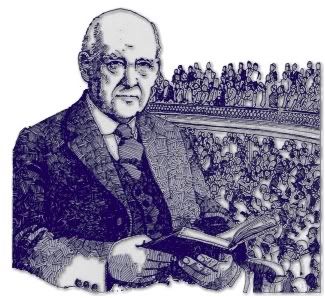 Martyn Lloyd Jones once remarked that he wouldn't cross the street to listen to himself speak. Now, anyone who has heard a recording of MLJ would be amazed at such a statement. MLJ was a brilliant communicator, articulate, intelligent, humble, thoughtful - a craftsman who glorified the Lord from the pulpit weekly - and even beautifully; I mention this by way of introduction. Martyn Lloyd Jones once remarked that he wouldn't cross the street to listen to himself speak. Now, anyone who has heard a recording of MLJ would be amazed at such a statement. MLJ was a brilliant communicator, articulate, intelligent, humble, thoughtful - a craftsman who glorified the Lord from the pulpit weekly - and even beautifully; I mention this by way of introduction.
When my church began to put audio recordings of the weekly sermon and Adult Sunday School stuff online, I began to have convenient opportunity to (occasionally) download one of my messages and give it a listen; and frankly, whenever I do that I give serious thought as to whether I should be speaking in public at all!
As I listen to myself I think - Doh! I should have said this, or maybe I should have said this thing another way. Arn't I talking way too fast? Why is my voice so annoying? Speaking of annoying, why do I keep saying "okay?" and "right?" every five minutes? No matter how much effort I put into preparing a sermon, I never seem to glance down at my notes once I start speaking - I almost always start winging it as soon as I get in the pulpit.
Now that is not to say that I am just improvising, I am not - I know what I want to say and I try to stick to it, but as I preach I am often looking at, and taking my cues from the congregation. If they seem to understand what I am saying, I move on, but if they look perplexed I explain myself in another way, often requiring some tangential information be brought to bear - information that isn't in my notes - and once I get off my notes, getting back on them with any sense of congruency is sometimes difficult. ;-)
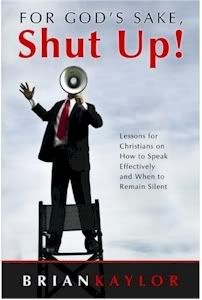 I am still pretty new at this, and I trust the Lord to grow me in this too, that is, if it really is His will that I continue teaching in this way - yet I find when I listen to myself preach I am so critical of myself I find it discouraging. I almost want to adopt a feigned histrionic - to craft my presentation like an actor - you now, to write out a script, stick to it, and carefully determine before hand the metre and volume, where to make that voice-cracking passionate plea, where to thunder, where to adopt that quiet, conversational tone - to prepare the sermon before hand, and thereafter polish my oratory skills so that the message has the "greatest effect." I am still pretty new at this, and I trust the Lord to grow me in this too, that is, if it really is His will that I continue teaching in this way - yet I find when I listen to myself preach I am so critical of myself I find it discouraging. I almost want to adopt a feigned histrionic - to craft my presentation like an actor - you now, to write out a script, stick to it, and carefully determine before hand the metre and volume, where to make that voice-cracking passionate plea, where to thunder, where to adopt that quiet, conversational tone - to prepare the sermon before hand, and thereafter polish my oratory skills so that the message has the "greatest effect."
I say, I almost want to do that, or perhaps more accurately, I know that deep down I really want to do that; but for all the wrong reasons. First there is personal glory - the desire to be admired not only for the rich content, but also for the excellence of the presentation - which is vanity and pride. Mixed in is the deceptive lie that really I just want to make the biggest impact for Christ - but that is a lie from hell - founded as it is upon the erroneous thought that God's word is made more effective by a skillful preacher. God's word is effective because it is God's word. The gospel will save people even if Satan preaches it. God's word goes out and does not return to him fruitless - it bears the fruit that God sent it out to bear.
So instead of improving my histrionics, I entrust myself to God, if He is glorified by making me a better speaker, then let him be glorified in that, and if He is glorified by allowing a donkey to speak - then I am pleased to speak as a donkey. Woe to me if, given the chance, I would allow my vanity to rob God of His glory just to admire myself!
On that note I submit to you my sermon from Sunday. My pastor was preaching at another church, so I got to give the sermon. I preached on walking in the Spirit, and in particular the greatest hindrance to walking in the Spirit - walking in the flesh.
If you are inclined to listen to me say "right?" and "okay?" more often than is tolerable, and to flip around in my bible looking for verses I can't seem to find, and to wander off my notes so that the point I am making seems disjointed and hard to follow - and if you like to listen to a sermon preached in a voice that has no pleasant timbre, accent, or even mannerism, at a pace that seems at times too fast and at times jarringly halting - then I invite you to listen to this past Sunday's sermon here, and if there is anything praiseworthy in it, I can at least be certain it is not because of my oratory skill, but because we serve a God who is glorious.Labels: audio, church, encouragement, sanctification |
|
posted by Daniel @
3:02 PM
6 comment(s)
|
|
|
|
| Everyone Wants To Fix The Church. |
 Every now and again, a sense of jealousy rises up in my heart - not over my wife, but rather over the church. I burn with jealousy to see her wooed by (and flirting with) the world and its wisdom and ways. Every now and again, a sense of jealousy rises up in my heart - not over my wife, but rather over the church. I burn with jealousy to see her wooed by (and flirting with) the world and its wisdom and ways.
There is a wonderfully poetic quote that I can't quite remember (and I haven't been able to Google with any success) that, roughly paraphrased, goes like this: One man looks and sees a pile of stone, but another sees a church. I am not really capturing the thrust of the original quote - because upon reading it the first time I was struck with that kind of awe you get when a thing is "well said" - what struck me when I read the real quote (I mention it now because my awkward paraphrase doesn't capture the sense) was that the first person couldn't comprehend the fine masonry and intricate stonework as anything more than a pile of stone. He was correct of course - this ornate structure was a pile of stone - but the other was able to "make sense of it" and see that this pile of stone was in fact a magnificent cathedral.
Remember the Market, er, I mean the Trend, er, I mean the Purpose Driven Church? Remember the prayer of Jabez? How about the New Perspective on Paul? What about the emerging church? Everyone wants to tell us how to "do church" better.
We could discuss the various merits and obvious flaws of the existing methodologies, approaches, philosophies and whatnot - and I sure others are doing that somewhere even as I type this - but frankly, it is a pointless pursuit. In ten years there will be another half dozen or more "better" strategies for building, fixing, motivating, improving or otherwise repairing the existing church - and as many (and likely more) in the decade after that and so on ad nauseum.
Everyone seems convinced that the church is not what it should be - but everyone seems to have a different spin on what "what it should be" is.
I think we could examine every new "solution" with scrutiny to see if this is the "one" final solution - or, if we are like many - perhaps we will simply take a little "good" from here, and a little "good" from there and sew them into our Christian practicum like so many patches on a patchwork quilt. Eventually we may arrive at something that is closer to "the true church" (cue the "holy reverence" background music) - and since that seems to be a good thing to do, and since it is clearly better than nothing - why knock it?
Well, I will knock it, because, as I said, I burn with jealousy on occasion, and since this is my blog, I can vent that jealousy and let the chips fall where they may.
The "problem" with the church is not that we aren't doing church right - it is that we aren't doing Christ right. No one can see the love of God flowing out of someone whose greatest love is themselves. Listen: a stubborn, unsurrendered heart looks to all the world to be just like any other worldly heart. How can someone who always resists the Holy Spirit expect the love of God to be seen in them? You waste your time when the best you do is approximate in practice what surrendering to Christ would look like if you were actually surrendered to Him. Let me tell you, an approximation looks fantastic on the outside - it can even look genuine and fool everyone around you - but it shows itself for what it is in this way - it has absolutely =no= spiritual power whatsoever.
I think it was an unsaved politician in India who once remarked that Christians make such extraordinary claims while living such ordinary lives.
That is just plain sad because, for the most part, it is stingingly accurate.
If you want to improve the church, start at the ground level - the fallow ground level. What the church needs is not a new plan, it needs surrendered saints. The problem isn't that we don't have the right method, it is that we don't have a right heart. There is no room and no provision for mediocrity in the church.
My plea this morning - and going into the weekend - is this: If you are in Christ and as you read this you are not absolutely surrendered to God - stop putting it off! Listen: God loves you and even if as you read this you are nursing your sin - trust in God's forgiveness and love and put away the sin - do that and God will give you grace, but don't just do it in your head - don't just say, "Dear God, I am a sinner, please forgive me - I will do better next time. Amen." - tell God the truth - "Dear God, I know I should love you and love pleasing you, but I have been telling myself that you don't love me because I am such a phony. I have been telling myself that you can't love me until I am a good person - I have been trying to make myself acceptable to you and in doing so I have demonstrated that I don't really believe Christ's death satisfied your wrath towards me - forgive me my unbelief, forgive me my lack of love - and grant me this - that I would trust in your love and in your Christ, and that in the strength of that trust I would walk not only in the coming moments but throughout the day, throughout my life. Cleanse me as you promised, I will turn from the unbelief that separates us, and ask only that you replace in me this unbelief with faith through your Holy Spirit's filling. Grant me the strength in grace to walk right before you. Amen" - or something like that.
I think that if we spent more time fixing Christians we would not be so preoccupied with trying to fix the church.Labels: church, encouragement, union with christ |
|
posted by Daniel @
7:09 AM
14 comment(s)
|
|
|
|
| The Gap. |
 As a young man in high school, when the guys would get together and kid around, we used to imitate talking like Elvis for laughs, I can still hear my friends trying to master the art of saying, "I'll ah, I'll have a big 'ole cheese bugga, and ken ya put a whole lotta mayo on that darlin'?" We cracked ourselves up thinking we were so clever and funny. As a young man in high school, when the guys would get together and kid around, we used to imitate talking like Elvis for laughs, I can still hear my friends trying to master the art of saying, "I'll ah, I'll have a big 'ole cheese bugga, and ken ya put a whole lotta mayo on that darlin'?" We cracked ourselves up thinking we were so clever and funny.
I mention this so that when I say that there is in many of us a "whole lotta" difference between what we intellectually agree to be true and what we put into practice.
Consider the following quote from Walter Marshall, first published in 1692:Consider these things well, and you may easily perceive that our spirits are not in a fit frame for the doing of them, while we apprehend ourselves under the curse and wrath of God, or while we are under prevailing suspicions that God will prove an enemy to us at last. What Marshall is saying here is that you can't really love God if you always hold onto the secret suspicion that God is really your enemy. The context (and you can go and read the whole book at the link) is that until a believer is convinced in a practical way that they are in fact reconciled to God, they will be unable to accept the truth that God loves them in any practical way.
I think the best path for discipleship is to identify the most common obstacles to (genuine) Christian growth, and deal with them first. But often new believers are either left to their own devices (worse case scenario), or given a brief and systematic overview of the core Christian beliefs and encouraged to study the bible and pray (a little better), or thoroughly indoctrinated into both the core beliefs of the Christian faith and a variety of denominationally appropriate theological dogma (magnificent, but still putting the cart before the horse).
You see, you can be a believer, and have your head filled with all the right interpretations of all the various doctrinal stances your theological persuasion allows - and all the while be hopelessly in bondage to sin because in spite of all your "learning" - you didn't believe some of the very first things you were supposed to learn. There is a "Gap" between what you know to be true intellectually, and what you see happening in your faith.
You know, for example, that God loves you. If someone asks you, you have the right answer - "Jesus loves me this I know, for the bible tells me so" - only deep down, you suspect that every time you failed to be perfect, God stopped loving you. Oh, it was your <whispering> deep, dark secret, </whispering> but you imagined that this doubt was either normative, or more likely, that your faith was somehow flawed, and that if you could just obey more genuinely it would go away. But it never did.
You see, the gap? They are trying to generate God's love by their genuine obedience. Oh it looks crazy when we drag it out into the light and look at it, but that is what can happen.
You see, unbelief is spiritual cancer, it grows over time and gets worse - and unless it is identified for what it is, a person may well wonder why they seem to be getting worse in their faith rather than better, why they seem farther away from God now, than ever before. The problem goes back to the basics:
=If= you are in Christ, you are acceptable to God right now, and no sin that you can ever commit will change that. You cannot make God love you by your "genuine obedience" - God's love cannot be purchased - it is freely given, and if you are in Christ, it is already yours.
You are reconciled - the gap between you and God has been filled entirely because you are in Christ. God loves you right now, and so long as you continue to imagine that God's love is conditioned upon your obedience, you will never be able to believe that God loves you. And though you must become a fool to understand this, since it goes against all our logic - THAT must come first. First you trust God's love, and when you do THEN obedience flows naturally out of you.
Brother, sister, are you convinced intellectually that God loves you? Do you find that secretly you aren't loving God? It is because you are wrongly prefacing God's love upon your obedience - and as long as your conscience refuses to trust in a perfect and completed reconciliation - you will never be released from the guilt of your sin, and until you are released thus, you will not be free to love God from your heart. Your mind may well agree that loving God is proper, but your heart won't be convinced.
So if this was written for you, let the Spirit witness that to you, and do something about it. Crack open your bible while it is still today and settle for yourself whether God prefaces his love towards you on your good works. Learn that God's love is real, and stop giving into unbelief. It is true that you are not worthy of this profound love that God has exercised towards you - but it is high time you excusing your guilty conscience as a pious thing - when your conscience is trained not by truth but by suspicion, it is an evil conscience - you must train it again with the truth, for such will set you free.Labels: encouragement, helpful, Instruction, love, Theology |
|
posted by Daniel @
8:51 AM
5 comment(s)
|
|
|
|
| Lables and Libel... |
Here is the prayer that I prayed just now because I was quite concerned that I might write a post that wasn't very honoring to our Lord:
Lord, you are sovereign, and some of your precious children will be reading what I write here. Grant me the grace to be submitted to your will as I write this out, and allow your love for them to be my love for them so that I would encourage and edify those whom you love - for your glory, and for the sake of the church you love, in the name of your Son I ask this, because His hame is perfect, Amen.
Brother, sister, if you are convinced that your theology is more perfect than that of the Christian beside you, then go to him in love and share what you have known. If there is any truth in what you share, God will use that to open his eyes. You cannot convince another of truth, that is the work of Christ. Go to your brother with your five loaves and a few fish rejoicing for God can multiply them in your brother's heart.
But if you are learning to bait your brother, and tease him for what he or she believes - if you are willing to strike back when his theology insults you - then there is either something wrong with your theology, or you are an empty theologue, one who assents that a truth is true, but doesn't lift a finger to live it out.
Do you hate Arminianism? Do you hate Calvinism? Is that what defines your faith - how much you hate someone else's? If you are apt to teach then teach, but if you are just a clanging gong -a viper spitting your venom at those who disagree with you- perhaps you would take some advice? Love the Lord, and you will not find it in your heart to hate your brother, to ridicule or bait him or to make yourselves stumbling blocks before him. It is better for you to close your mouth in love than to open it in hate.
If another isn't seeking the Lord as diligently as you and your cadre, I hope you will choose to encourage their efforts rather than poke "fun" at them. By now it is high time you learned to blush.Labels: encouragement, sectarianism |
|
posted by Daniel @
7:47 AM
8 comment(s)
|
|
|
|
|
|

