|
|
| |
 - Endorsed - Endorsed - Indifferent - Indifferent - Contested - Contested
|
| |
| The Nashville Statement
|
| |
|
|
| |
 Name:Daniel
Home: Winnipeg, Manitoba, Canada
About Me: I used to believe that evolution was reasonable, that homosexuality was genetic, and that people became Christians because they couldn't deal with the 'reality' that this life was all there was. I used to believe, that if there was a heaven - I could get there by being good - and I used to think I was more or less a good person. I was wrong on all counts. One day I finally had my eyes opened and I saw that I was not going to go to heaven, but that I was certainly going to suffer the wrath of God for all my sin. I saw myself as a treasonous rebel at heart - I hated God for creating me just to send me to Hell - and I was wretched beyond my own comprehension. Into this spiritual vacuum Jesus Christ came and he opened my understanding - delivering me from God's wrath into God's grace. I was "saved" as an adult, and now my life is hid in Christ. I am by no means sinless, but by God's grace I am a repenting believer - a born again Christian.
My complete profile...
|
| |
Daniel's posts are almost always pastoral and God centered. I appreciate and am challenged by them frequently. He has a great sense of humor as well.
- Marc Heinrich
His posts are either funny or challenging. He is very friendly and nice.
- Rose Cole
[He has] good posts, both the serious like this one, and the humorous like yesterday. [He is] the reason that I have restrained myself from making Canadian jokes in my posts.
- C-Train
This post contains nothing that is of any use to me. What were you thinking? Anyway, it's probably the best I've read all day.
- David Kjos
Daniel, nicely done and much more original than Frank the Turk.
- Jonathan Moorhead
There are some people who are smart, deep, or funny. There are not very many people that are all 3. Daniel is one of those people. His opinion, insight and humor have kept me coming back to his blog since I first visited earlier this year.
- Carla Rolfe
|
| |
|
email
|
|
| What is expected of a member in a local, Christian congregation? |
I don't think church covenants are biblical. That's not all that fascinating. I doubt anyone would argue that a church covenant is biblical. I think some folks like church covenants because they are so practical when it comes to pointing at something and saying, "See! This is what you signed your name to when you became a member!"
I mean, don't get me wrong, I like pacts as much as the next guy, but I think I would rather appeal to God's spirit and church discipline than to a signed contract both when it comes to discipline, and when it comes to encouraging someone to go deeper in their walk with Christ.
Again, I think it is very good --nay, imperative to have clearly defined expectations of what membership means when someone is considering joining a local congregation. I just don't think it should be a pact - since that inevitably will end up in someone making an appeal to a page you signed rather than to God and your sin.
I don't think a list of expectations has to be overly formal, but it should be clear and well explained from scripture. Truly, you could summarize such a list in a single sentence: "We expect you to conduct yourself according to the commands of scripture" - the trouble is a lot of Christians don't know the scriptures, and as such couldn't articulate off the top of their head, such notions as I am about to articulate off the top of my head.
I think a list of expectations of membership in a localized Christian congregation should begin with the expectation that a person is actually a Christian.
You could write something like this:
Above all else, members of the local body (congregation) of Christ are expected to be genuine Christians.
Then flesh it out thus:
According to the scriptures it is God's breath that has imparted life to each and every one of us. God breathed into Adam and Adam became a living being (cf. Genesis 2:7), and if God gathered to Himself this same breath by which we have our own lives, all flesh would perish together (cf. Job 14-15). When Adam disobeyed God, that act of disobedience brought into being a separation between God (the source and sustainer of our life) and mankind. The bible describes this as Adam's sin bringing death into the world (cf. Romans 5:12). Furthermore, God cursed all of creation in the wake of Adam's disobedience (cf. Genesis 3:14-19).
We are, by the nature of our existence, obligated to obey our Creator who, by His own grace and mercy, sustains our daily lives. Yet every person condemns themselves when they begin to obey their own will and (in enmity against God) reject God's rule over them (cf. Romans 5:18, 8:7).
To be sure, the scriptures teach that one significant effect of our having become estranged from God in this way is that no one by themselves will ever want (or can ever secure) reconciliation with God (c.f Romans 3:10-12).
In order for a sinner to seek reconciliation (and thereby salvation), the scriptures tell us that God Himself must draw the sinner into it (cf. John 6:44,65). The sinner is by no means the instigator of this salvation, but Christ (in response to the will of God the Father) initiates faith in each and every believer (cf. Hebrews 12:2).
Scripture teaches that before the foundation of the world God chose or determined (elected/predestined) exactly who He was going to extend mercy to, and that He likewise determined to bring a just judgment on those whom He did not determine to show mercy upon (cf. Ephesians 1:4; Romans 9:15,18).
Scripture teaches that the grace that God extends to those whom He justifies is not something God is obligated to provide, lest it no longer be grace, but a wage that must be paid (cf. Romans 11:6). When God's extends grace to one sinner, that does not obligate God to extend the same grace to all sinners.
Even though no person can seek God unless God Himself has already chosen that person, this does not make God culpable in commanding all of mankind to do what no individual is able to do (repent and believe the gospel). The scriptures teach that no person is able to keep -any- of God's commands; in fact the scriptures plainly state that the purpose of God's command is to teach us the truth about ourselves - that we are sinful to the core, and in need of a Savior.
Given that no person on earth is able to repent in and of themselves, God must (and does) grant (as a gift of His grace) this ability to those whom He draws to His Son.
Thus a Christian is a sinner in whom God produces a desire contrary to the world, a desire that eventually drives the sinner to surrender the rule of their life over to God (i.e. repent), and who abandons their own righteousness, having instead believed the good news concerning salvation - that God has provided a way for sinners to be reconciled to Himself by exercising faith in the finished work of Christ on the cross, whereby those sinners who repent and believe are baptized into Christ who becomes their sin, and is put to death by God for the same sin, which upon Christ's death satisfied God's wrath that was directed at those sinful believers who were united together with Christ by faith through their baptism into Christ, so that when Christ died, the debt of their sin was paid in full, and again, when Christ was raised, they were likewise raised with Him by reason of that same Spiritual union by which Christ was able to become their sin - in this way His life becomes the life of all who were in Him by faith.
We expect, therefore, members of the local congregation to have surrendered the rule of their life to God, and to have been reconciled to God through faith in Jesus Christ. While we do not expect everyone who has been reconciled to God through a repentant faith to articulate all aspects of their regeneration, we do expect every member to be able to articulate without confusion, the gospel by which they themselves entered into the Christ's kingdom.
I mean it doesn't have to be perfect, but it should make clear the fact that you're not a Christian if you haven't ever surrendered your life to God's rule and turned to Christ in faith to be saved from your sin. Who knows? Maybe expecting your members to be Christians is a little over the top for some, but I am picky that way.
Again, I would say the next thing you would expect from a member is that they understand that membership is not optional. It isn't that they have to join themselves to your congregation - but that if they are going to obey God at all, they -must- join themselves to a local congregation of believers.
So I would probably put in something like this:
All believers everywhere are expected to become a member of a local body;
I would then offer some explanation such as this:
The Author of Hebrews writes that members of a congregation are to obey their leaders and submit to them because these same leaders not only keep watch over the souls of the congregants but will have to give an account to God concerning how they have kept the flock (cf. Hebrews 13:17).
From this passage we conclude that merely gathering regularly with a body of believers does not (and cannot) constitute membership in that body. Membership in the body necessarily requires a would be congregant to submit himself or herself to the leadership of that body, who likewise accept the responsibility, and will answer to God for, the keeping of their souls.
Likewise from this same passage we conclude that a congregant should not be a member of more than one local body at any one time, since that would require there being more than one elder or group of elders taking spiritual responsibility for the soul of the congregant at the same time.
Furthermore we conclude from this portion of scripture that what God commands, God intends. That is, we conclude that it is God's intent for every believer be joined to a local congregation in order that each believer may either be recognized as a leader and enter into the ministry of keeping the souls of the congregation, or again recognized as a member who willingly and in obedience to scripture submits himself or herself to those same leaders whom God has appointed over them.
Finally we conclude from this passage that those who profess faith in Christ but who likewise refuse to become members of a local congregation, are not rejecting the ordinance of man, but the ordinance of God.
Having clarified that you need to be a Christian in order to be a member of a local congregation, and then again, that every legitimate Christian must (if they are to be obedient to the Lord) join themselves to a local congregation), I would begin to summarize what proper Christian conduct looks like, and present that conduct as an expectation of membership.
I might flesh that out too, you know with a heading like:
What the local congregation expects from every member
followed by a quick summary like this:
The local congregation expects every member to act in accord with the teachings of scripture in all matters and at all times. Yet specifically, as pertains to "church membership" the following items have been highlighted.
And then a grouped summary on various points like this:
1. Members of the local body of Christ are expected to conduct themselves in all aspects of their life, both in and out of the church, in a manner worthy of the calling to which they have been called.
In Ephesians 4:1-3 the Apostle Paul urges the believers at Ephesus, and through them, urges every believer everywhere, to walk in a manner that is worthy of the calling to which God has called them. We are commanded to conduct ourselves with all humility and gentleness, bearing with one another in patience and love, being eager to maintain the unity of the Spirit in the bond of peace.
Because God commands all believers everywhere to walk in a manner that is worthy of the calling to which they were called, we must expect members of the local body, by extension, to do the same.
For this reason we expect every member of the local congregation to continually conduct himself or herself in humility. Humility, in this sense, does not mean that we regard ourselves with a self deprecating eye, rather it means that members of the congregation are expected to pursue in themselves a more perfect obedience to God's will; having (or working towards) a settled and uncompromising submission to God's clearly stated will.
Likewise, for this reason we expect every member of the local congregation to pursue (in all things): gentleness, patience, and a genuine love for the brethren, in order that the unity of the local body will emanate from a mutual submission to God's will.
I would probably have to say something about the expectation of a member respecting the authority of scripture:
2. Members of the local body of Christ are expected to submit to the authority of scripture on all matters pertaining both to individual and corporate Christian conduct.
In Paul's second letter to Timothy, he describes all scripture as inspired by God and profitable for teaching, for reproof, for correction, and for training in righteousness in order that believers may be adequately equipped for every good work. (cf. 2 Timothy 3:16-17)
From this passage we conclude that the whole of scripture is given by God to the church not only for instruction, but also for correcting errors in understanding of the things of God, and again for reproving transgressions against God. The local member is expected not only to [1] freely acknowledge the scriptures as the final authority on all matters of doctrine and conduct, but likewise to [2] resist the intrusion of any authority that contradicts the authority of scripture.
And something about the expectation that every member would maintain the purity of the gospel:
3. Members of the local body of Christ are expected to affirm the gospel of Jesus Christ and again to oppose and expose any and every attempt to corrupt that gospel in the local assembly.
Scripture teaches that false people will eventually join themselves to a congregation and by their actions destroy the unity of the congregation, and undermine/water down the truth of the gospel (cf. Matthew 7:15; Acts 20:29).
Members are expected to recognize and oppose/correct/expose any teaching or teacher who teaches a version of the gospel that contradicts the gospel as found in scripture.
Oh, let's not forget the expectation that Christians actually grow:
4. Members of the local body of Christ are expected to pursue grow up into spiritual maturity, and provoke others to
In 2 Peter 3:18, The Apostle commands Christians to grow both grace and in the knowledge of Jesus Christ. By extension, members are expected to obey this Apostolic command through regularly reading/studying of the scriptures, through prayer (both individual and corporate), and through submitting themselves to the clearly stated will of God in scripture.
It is God's will that:
[1] we be saved and come to the knowledge of the truth (cf. 1 Timothy 2:4),
[2] we find out what His clearly stated will is (c.f Ephesians 5:17)
[3] we abstain from drunkenness (c.f. Ephesians 5:18)
[4] we be filled with the Holy Spirit (c.f. Ephesians 5:18)
[5] we be sanctified, abstaining from sexual immorality (1 Thessalonians 4:3)
[6] we submit ourselves to those whom God has placed as authorities over us, both political (1 Peter 2:13) and spiritual (Hebrews 13:17, Peter 5:5, Ephesians 5:23-24)
[7] we confess our sins to one another (cf. James 5:16)
[8] we pray for one another (cf. James 5:16)
[9] we encourage in our walk and in our faith daily (cf. 1 Thessalonians 5:11, Hebrews 3:13)
And what of the expectations of good stewardship?
5. Members are expected to be faithful stewards of all that God has given to them, and also to support, whenever applicable, the work of the Spirit in the local congregation (by and through whatever variety of resources they find themselves in possession of).
Children: members are expected to diligently instruct their children in the Christian faith (cf. Deuteronomy 6:6), to discipline their children when they err (Proverbs 13:24).
Time: members are expected to make the most of the time they have on left on this earth in the service of their king, abounding in the work of the Lord (cf. 1 Corinthians 15:58, Ephesians 5:16)
Wealth: Members are expected to honor the Lord with their wealth (cf. Proverbs 3:9)
Talents and Gifts: A talent is a skill you have developed through practice whether natural or affected, and a gift in this context is a spiritual endowment whereby you are motivated by the gifting you have received from the Holy Spirit on the day that you were baptized into Christ through faith. Whether a talent or a gift, we expect members to magnify God and bring glory to His name by employing both talents and gifts according to every opportunity and all our ability.
And you can't have elders in two congregations both answering to God for the same souls:
6. Members who are elders are expected to keep watch over the souls of the local congregation, knowing that they will eventually have to give God an account of their ministry. Likewise members of the local congregation are expected to submit themselves to the spiritual authority of those whom the Lord has set over the congregation for this purpose.
Let's not forget purity - how many people engage in impurity regularly - we potential members to know that this is not acceptable Christian conduct:
7. Members are expected to flee from all manner of sexual impurity
Members are expected to live free (and if applicable, to genuinely seek freedom) from all manner of sexual sin including, but not limited to: pornography, masturbation, premarital sexual activity (this includes everything from a kiss you wouldn't give your grandmother to copulation), extra-marital sexual activity, lust, adultery, homosexuality, and bestiality.
Members are not to live in "common-law" relationships, which although accepted by our culture, are not acceptable to God given that they cohabiting with a sex partner who is not a spouse.
Sexual sin is an abomination, and members are expected to live in freedom from these sins.
We could go on, touching on church discipline, what is expected regarding submission to elders on spiritual matters, that as a member they a person is expected to minister with their gifting to the body they are joined to regularly, whether that means something formal, or informal, and maybe how we expect every member to be making war (and not peace) with the sin in their life etc.
The point is that a list of expectations is probably a good thing. You can even have a prospective member sign some form that says they have read what is expected of them and agree that what is expected is biblical, but I would personally stop short of turning such a thing into a signed commitment (read: pact/contract/covenant) because I believe that we have something better to appeal to than a signature on paper - and I think you know what I'm talkin' about.
I don't write this today arbitrarily either. My congregation is meeting tonight to discuss these things and I want my head on straight before I get there. Sometimes writing out my thoughts helps me to organize them. Should churches have church covenants, or is that just a carnal crutch? What should a covenant look like, or a statement of the expectations of membership? Is a statement of expectations all we need? How should we present whatever we present? Should it be a signed commitment (a covenant by any other name), or just as an informational summary of what is expected of every believer? Do we go beyond scripture on the grounds that we are being "orderly" or do we guard ourselves against pragmatism etc.?
My hope for our congregation, and yours if you are reading this and thinking about your own situation, is that whatever we do we do it for God's glory, and that whatever we do informs potential members of what is expected of them in the local congregation.Labels: church, membership |
posted by Daniel @
1:51 PM
6 comment(s)
 
|
|
|
|
| What if church is boring? |
First of all, church isn't what happens on Sunday morning. If you are bored with your Sunday Service, you aren't finding church boring, you are finding your Sunday morning service boring. There is grand difference between the two.
The church isn't the service, and it isn't the building, it is the term we use to describe the body of Christ, that is, the body of believers. To say that you find church boring is to say that you find other Christians boring, and that is probably not true.
In fact, the first notable sign of spiritual life is that strong and pressing desire to get with other Christians and speak (and listen talk) about the things of God. Fellowship is almost always interactive and conversational - a sharing in that union by which we who are in Christ were joined to Him.
I don't doubt that one of the reasons we have things like the "house church" movement or the emergent church - is to try and turn Sunday mornings into formalized fellowship. To try and capture what ought to be the flavor of our fellowship when gathered together for mutual comfort and conversation, and turn -that- into our coffee sipping Sunday service (disservice?)
Christians should have fellowship with other Christians. They should get together for prayer, bible study, and the fellowship that comes unrehearsed when gathered for these reasons. While this is vital to the health both of the individual and the church, and while we might even call this the bread and butter of church life - it is not what is supposed to be happening Sunday morning.
On Sunday morning, the early church gathered together - all of them. They were given instruction from God's word on how to live according to the new covenant. They were made aware of needs and given opportunity to meet those needs in prayer and again in providing from their own means - you know, the one who had two gave one to the one who had none. This was the work of the Spirit. In some ways it was probably more formal than most of our Sunday services, and again, in other ways, less formal.
I doubt many of those meetings were very entertaining, yet people who were focused on Christ probably enjoyed these times immensely, not for their entertainment value, but rather because they loved Christ, and loved the fruit of the ministry that was going on every Sunday morning.
Here then is the wrong heart for Sunday morning: The heart that wants to be served. The formal weekly gathering of the early church on Sunday mornings was never a production - never a consumer event. You didn't come to consume entertainment, or even personal enrichment. You came to serve. If I can be bold here, this was true, not only of Sunday morning, but of everything they did. They didn't call themselves "slaves of Christ" as a sort of rustic sounding but ultimately vain label, the way many do today. A slave of Christ gathers with the body of Christ to serve it. Where Christ is, there His servant is also. If Christ came to serve, guess what?
I know a great many think of serving as something we do elsewhere. Often we think of Christian service as something you do "outside of church". You know, hand out gospel tracts on a street corner, or evangelize door to door, or start up some kind of "helps" ministry. More often than not, we tend to let our money work instead of our hands however - giving money to others who feed and clothe the poor in our name - or share the gospel. We call that "giving to missions" etc. I would hazard to guess that most Christians "give" so that they don't have to "do". They are far more willing to part with some portion of their disposable income, than they are to minister to the needy in this world. That is just an observation. If the Holy Spirit uses that to convict, let it be.
All I am saying is that when we think of service as something external, we tend to think either in terms of missions or some sort of helps ministry, either personal or put on by the "church". We think of those who have a microphone on Sunday morning as the ones who "minister" to the body, and everyone else as being "ministered" to. Such that everyone who shows up on Sunday morning and isn't involved in the "ministry" is there to consume it - and I don't think that is what Sunday morning was like in the early church.
I am not saying that it wasn't present to some degree - people and sin being what they are, it probably didn't take long to fall into the kind of consumer-driven meetings that make up the majority of Sunday services in our day. What I am saying is that if you find Sunday morning boring, it is because you are not there in the Spirit, but there in the flesh, as it were. You have not come to serve, but to be served, and having come thus, you now find the fare not up to your standards because you have an expectation that isn't being met.
Maybe you want to be entertained. Maybe you want to be informed. Maybe you find the formal service gratingly routine. Maybe you don't like the preaching, or the preacher, or the singing, or the song leader, or the songs, or the music, or the pews, or the view out the window, or the sounds of traffic, or the type of music, or the decor, or the carpet.
Maybe it is something less tangible, like a vague but overwhelming sense of spiritual inertia, the sense that God -isn't- working in "this" church, and that because we are "doing" church wrong - a creeping bitterness that things are happening at the spiritual pace you think they ought to be. Maybe you think the leadership is weak, or the teaching doesn't reflect your personal theological bent, and this gnaws at you on Sunday morning, so that your Sunday mornings do little more for you than foster and feed the growing and bitter criticism that is slowly devouring and defining you.
Whatever the case, if you find Sunday services boring, it almost certainly has far more to do with you and your heart than it does with the service itself. If you came to serve, and you came in the Spirit (and frankly, you can't have one without the other), then you will come with patience, and with your ear to the ground, anticipating God's work, glorying in it, and doing whatever is in your power to see God glorified in it. If that means digging deep within to sing from your heart that tired old cliche of a pop chorus yet again, or again, if that means buckling down on your wondering mind so that you are listening intently to the latest in a protracted series of (what you consider to be) wiener-water sermons - then do that; but remember you have come to serve, and in these things, find a way in Christ to serve the body as you do them. Are the sermons weak? How much time did you pray this week for the message? Are the "worship" songs superficial? Again, have you labored at the throne this week, for the songs, the singing, and especially for your own heart, that you might receive these, such as they are, with maturity, grace, and joy? Do you receive these things with a tender heart that marvels at God's patience in these matters, and comes along our Christ in prayer, interceding for these things, that God may be more evident in our song, in our prayer, and in our instruction? Or do you ignore them until Sunday, then complain in your heart that they are not what they could and "should" be?
Maybe you truly are in the deadest church in town. Maybe you really are in the midst of a carnal throng that wouldn't know fellowship if it hit them upside the head. But that is no excuse for your attitude on Sunday morning. If you come to congregate with God's people and you recoil from it because you find it boring - let me tell you, you're heart isn't in it, and if your heart isn't in it, it is because you heart is somewhere else. It has nothing to do with how good the preaching, singing, or service happen to be, and has everything to do with where we personally are in our walk with God.
Sunday morning is not boring, it is serving.Labels: church |
|
posted by Daniel @
7:19 AM
9 comment(s)
|
|
|
|
| Another Five Minute Post. |
As I was teaching Greek to my little ones yesterday morning, I began to correct the translation work of my eldest girl. She has been quite good at learning her vocabulary, and learning how to conjugate regular and irregular verbs, how to decline nouns of the first and second declensions, and a multitude of adjectives and prepositions. I say: she can work on this stuff without much supervision. But when we start to do the actual translation she has a miserable time with it.
She knows how to inflect a noun so that it is, say, in the Dative Plural, but she doesn't know when to use it or why you would ever give it that particular inflection.
Now in part this reflects upon my teaching. I have been focused on making sure we are all done our stuff before I go to work in the morning, and that has caused me on more than one occasion to project a "get this done at all costs now" sort of message, and this has been amplified by my daughters own task oriented focus. She is missing the big picture because she is focused on finishing and perfecting the little picture.
Now, it is good and right - and even critically necessary that she completely grasp the little picture; yet one need not do so at the expense of its application, in fact, to do so at the expense of application is a great misunderstanding of the very reason we are studying Greek. The ability to parse a noun or conjugate a verb is critical to correct translation - but seriously, it is just one piece in the translation puzzle. You must know why and when to use these words if you are going to translate from English to Greek or vice versa.
I take from this a lesson for the church. I see that to a greater or lesser extent, many Christians are more focused on the Sunday service than they are on the point of Sunday service. They come on Sunday, but they don't really know -why- they bother showing up - except because "that is what we do when we are Christians".
For some this is simply a habit, for others they are concerned about what people would think if they didn't show up, and for still others they come because it makes them feel good about themselves (less guilty), and some even come just to be entertained or to visit friends, and no matter how pious we personally happen to be, our old man is tuned in to one or more of these reasons. It is far easier to come to church in the flesh for the Sunday sermon than it is the Wednesday prayer night. On Sunday we can see and be seen, yet remain more or less anonymous, fulfill what is expected of us, and go home. But on Wednesday we are actually expected to participate - and frankly, talking to God is best done without hypocrisy, such that guilt will keep most people at home.
My encouragement this morning - brief as it is because I have to get going here - is to make certain that your religion sees the big picture. We do not congregate with other believers in order to "put in as much time as we feel obligated to surrender" -fostering a "just get it over with" mentality betrays our own ignorance of who we are in Christ. When a believer mistakes the reins for a pull rope, the church becomes a burden that he tries to drag around to satisfy God, but when he sees the reins for what they are, he gets on that pony and rides.Labels: church, encouragement |
|
posted by Daniel @
6:27 AM
5 comment(s)
|
|
|
|
| The Dross. |
In order to purify a metal, you typically heat up a chunk of metal enriched "ore" until it starts to melt down. Different impurities have different densities and melting points, and because metal is typically more dense, as you heat it up the metal pools at the bottom, and the impurities form a scum (dross) that floats on top of the refining metal.
The dross is not part of the metal, but has insinuated itself into the ore, and the refining process separates it from the metal. As the temperature increases, different impurities melt, and lacking the density of the metal, they float to the top to form new dross, thus the refining process works like this: The heat comes on - and things start to melt and separate. Dross forms, and is removed, then the temperature is increased. With the increase comes the melting of other impurities that were impervious to the lesser heat - but as these succumb, they too, being less dense, float to the surface and form a dross to be skimmed off. The process continues until no amount of heat will allow for anymore dross to appear. At this point the metal is refined, or as we like to call it - pure.
Certain metals have limited use and value while unrefined. Impurities can make a pliable metal brittle, can make a strong metal weak, can dull what ought to be a mirrored sheen.
Impurities can give a thing properties it shouldn't possess. Consider H20 (water). In it's pure state it isn't an electrical conductor - yet if there are enough electrolytes in the liquid, it will conduct electricity.
I was telling my little ones this morning that there are two types of people who call themselves Christians: The first group hates sin itself, but the other group only hates sins consequences. The first group is at war with sin in their life, while the second group avoids anything that will cause them personal difficulty. The first group weeps over their sin, while the second group is contented enough to put aside only as much sin as they have to. The second group doesn't hate sin, it just hates anything that would be an inconvenience to its own agenda. The first group give evidence of the life of Christ, and the second give evidence that they lack this same life.
In the professing church we are -all- sinners, whether our faith is genuine or counterfeit. We are called to refine and keep pure the professing church, and if we don't the impurities in it will change the nature of it. Though that ought to cause us to shudder, yet I know that many churches would rather tolerate sin than chance offending someone.
I haven't taken a poll, but I imagine that people don't want to confront one another about their sin because if they do, that will leave them open to reciprocal correction - and since we love our sin so much, we would rather keep quiet until we somehow eradicate sin in our own life first. Likewise, we are trained by this world to keep silent about our short comings. God forbid that someone from church should find out that we still haven't had a lasting victory over some pet sin, or that we have lapsed again into some area that we have enjoyed victory in previously.
Look: the church doesn't get any better until it gets serious about discipline, about dealing with sin openly, head on, and seriously. In fact, it only gets worse. Once the church is lukewarm, no one wants to turn the heat up and purge out the dross, for the dross has taken over.
Jesus made a lot of enemies amongst the spiritually dead when He took a whip into the temple - and you will make a lot of people angry if you plan on taking your lukewarm church into the fire. The dross is going to be ugly, and it is going to float to the top the moment the heat comes on. But if it is dealt with properly, you will have a stronger congregation for it.Labels: church |
|
posted by Daniel @
11:07 AM
6 comment(s)
|
|
|
|
| Off My Notes... |
 For those of you who don't read my blog all that much, I am a "teaching" deacon in my church - I am the chairperson of the Christian Education Committee, and I get to (informally) preach every Sunday to a small (but faithful) group of adults who attend our Adult Bible Study. For those of you who don't read my blog all that much, I am a "teaching" deacon in my church - I am the chairperson of the Christian Education Committee, and I get to (informally) preach every Sunday to a small (but faithful) group of adults who attend our Adult Bible Study.
Our former pastor began the Adult bible study a few years ago, and set the format - it ended up being a 45 minute topical sermon, wherein you could put up your hand and ask a question, though such a thing rarely happened. Even after he retired from being our Senior pastor, he continued to teach our Adult Bible Study, but being in his late eighties, and living a considerable distance from our church building - and being on a fixed income, and having our winters six months long, cold, and treacherous for driving - he found himself unable to make it to the services consistently, and having found himself often having to cancel at the last minute, he retired from the Adult Bible Study as well. That was when I stepped in, and I have continued the format - a 45 minute informal sermon, though while I still bring the occasional topical message, I have opted to exposit whole NT books verse by verse.
In that capacity I have had the opportunity to preach a lot over the past two years or so, and notwithstanding, I have had the opportunity on occasion to preach elsewhere - in other churches, and in my own church.
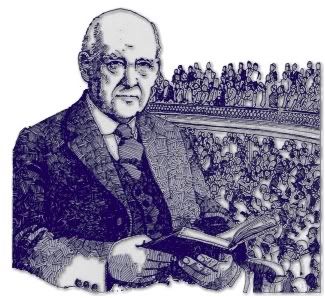 Martyn Lloyd Jones once remarked that he wouldn't cross the street to listen to himself speak. Now, anyone who has heard a recording of MLJ would be amazed at such a statement. MLJ was a brilliant communicator, articulate, intelligent, humble, thoughtful - a craftsman who glorified the Lord from the pulpit weekly - and even beautifully; I mention this by way of introduction. Martyn Lloyd Jones once remarked that he wouldn't cross the street to listen to himself speak. Now, anyone who has heard a recording of MLJ would be amazed at such a statement. MLJ was a brilliant communicator, articulate, intelligent, humble, thoughtful - a craftsman who glorified the Lord from the pulpit weekly - and even beautifully; I mention this by way of introduction.
When my church began to put audio recordings of the weekly sermon and Adult Sunday School stuff online, I began to have convenient opportunity to (occasionally) download one of my messages and give it a listen; and frankly, whenever I do that I give serious thought as to whether I should be speaking in public at all!
As I listen to myself I think - Doh! I should have said this, or maybe I should have said this thing another way. Arn't I talking way too fast? Why is my voice so annoying? Speaking of annoying, why do I keep saying "okay?" and "right?" every five minutes? No matter how much effort I put into preparing a sermon, I never seem to glance down at my notes once I start speaking - I almost always start winging it as soon as I get in the pulpit.
Now that is not to say that I am just improvising, I am not - I know what I want to say and I try to stick to it, but as I preach I am often looking at, and taking my cues from the congregation. If they seem to understand what I am saying, I move on, but if they look perplexed I explain myself in another way, often requiring some tangential information be brought to bear - information that isn't in my notes - and once I get off my notes, getting back on them with any sense of congruency is sometimes difficult. ;-)
 I am still pretty new at this, and I trust the Lord to grow me in this too, that is, if it really is His will that I continue teaching in this way - yet I find when I listen to myself preach I am so critical of myself I find it discouraging. I almost want to adopt a feigned histrionic - to craft my presentation like an actor - you now, to write out a script, stick to it, and carefully determine before hand the metre and volume, where to make that voice-cracking passionate plea, where to thunder, where to adopt that quiet, conversational tone - to prepare the sermon before hand, and thereafter polish my oratory skills so that the message has the "greatest effect." I am still pretty new at this, and I trust the Lord to grow me in this too, that is, if it really is His will that I continue teaching in this way - yet I find when I listen to myself preach I am so critical of myself I find it discouraging. I almost want to adopt a feigned histrionic - to craft my presentation like an actor - you now, to write out a script, stick to it, and carefully determine before hand the metre and volume, where to make that voice-cracking passionate plea, where to thunder, where to adopt that quiet, conversational tone - to prepare the sermon before hand, and thereafter polish my oratory skills so that the message has the "greatest effect."
I say, I almost want to do that, or perhaps more accurately, I know that deep down I really want to do that; but for all the wrong reasons. First there is personal glory - the desire to be admired not only for the rich content, but also for the excellence of the presentation - which is vanity and pride. Mixed in is the deceptive lie that really I just want to make the biggest impact for Christ - but that is a lie from hell - founded as it is upon the erroneous thought that God's word is made more effective by a skillful preacher. God's word is effective because it is God's word. The gospel will save people even if Satan preaches it. God's word goes out and does not return to him fruitless - it bears the fruit that God sent it out to bear.
So instead of improving my histrionics, I entrust myself to God, if He is glorified by making me a better speaker, then let him be glorified in that, and if He is glorified by allowing a donkey to speak - then I am pleased to speak as a donkey. Woe to me if, given the chance, I would allow my vanity to rob God of His glory just to admire myself!
On that note I submit to you my sermon from Sunday. My pastor was preaching at another church, so I got to give the sermon. I preached on walking in the Spirit, and in particular the greatest hindrance to walking in the Spirit - walking in the flesh.
If you are inclined to listen to me say "right?" and "okay?" more often than is tolerable, and to flip around in my bible looking for verses I can't seem to find, and to wander off my notes so that the point I am making seems disjointed and hard to follow - and if you like to listen to a sermon preached in a voice that has no pleasant timbre, accent, or even mannerism, at a pace that seems at times too fast and at times jarringly halting - then I invite you to listen to this past Sunday's sermon here, and if there is anything praiseworthy in it, I can at least be certain it is not because of my oratory skill, but because we serve a God who is glorious.Labels: audio, church, encouragement, sanctification |
|
posted by Daniel @
3:02 PM
6 comment(s)
|
|
|
|
| Everyone Wants To Fix The Church. |
 Every now and again, a sense of jealousy rises up in my heart - not over my wife, but rather over the church. I burn with jealousy to see her wooed by (and flirting with) the world and its wisdom and ways. Every now and again, a sense of jealousy rises up in my heart - not over my wife, but rather over the church. I burn with jealousy to see her wooed by (and flirting with) the world and its wisdom and ways.
There is a wonderfully poetic quote that I can't quite remember (and I haven't been able to Google with any success) that, roughly paraphrased, goes like this: One man looks and sees a pile of stone, but another sees a church. I am not really capturing the thrust of the original quote - because upon reading it the first time I was struck with that kind of awe you get when a thing is "well said" - what struck me when I read the real quote (I mention it now because my awkward paraphrase doesn't capture the sense) was that the first person couldn't comprehend the fine masonry and intricate stonework as anything more than a pile of stone. He was correct of course - this ornate structure was a pile of stone - but the other was able to "make sense of it" and see that this pile of stone was in fact a magnificent cathedral.
Remember the Market, er, I mean the Trend, er, I mean the Purpose Driven Church? Remember the prayer of Jabez? How about the New Perspective on Paul? What about the emerging church? Everyone wants to tell us how to "do church" better.
We could discuss the various merits and obvious flaws of the existing methodologies, approaches, philosophies and whatnot - and I sure others are doing that somewhere even as I type this - but frankly, it is a pointless pursuit. In ten years there will be another half dozen or more "better" strategies for building, fixing, motivating, improving or otherwise repairing the existing church - and as many (and likely more) in the decade after that and so on ad nauseum.
Everyone seems convinced that the church is not what it should be - but everyone seems to have a different spin on what "what it should be" is.
I think we could examine every new "solution" with scrutiny to see if this is the "one" final solution - or, if we are like many - perhaps we will simply take a little "good" from here, and a little "good" from there and sew them into our Christian practicum like so many patches on a patchwork quilt. Eventually we may arrive at something that is closer to "the true church" (cue the "holy reverence" background music) - and since that seems to be a good thing to do, and since it is clearly better than nothing - why knock it?
Well, I will knock it, because, as I said, I burn with jealousy on occasion, and since this is my blog, I can vent that jealousy and let the chips fall where they may.
The "problem" with the church is not that we aren't doing church right - it is that we aren't doing Christ right. No one can see the love of God flowing out of someone whose greatest love is themselves. Listen: a stubborn, unsurrendered heart looks to all the world to be just like any other worldly heart. How can someone who always resists the Holy Spirit expect the love of God to be seen in them? You waste your time when the best you do is approximate in practice what surrendering to Christ would look like if you were actually surrendered to Him. Let me tell you, an approximation looks fantastic on the outside - it can even look genuine and fool everyone around you - but it shows itself for what it is in this way - it has absolutely =no= spiritual power whatsoever.
I think it was an unsaved politician in India who once remarked that Christians make such extraordinary claims while living such ordinary lives.
That is just plain sad because, for the most part, it is stingingly accurate.
If you want to improve the church, start at the ground level - the fallow ground level. What the church needs is not a new plan, it needs surrendered saints. The problem isn't that we don't have the right method, it is that we don't have a right heart. There is no room and no provision for mediocrity in the church.
My plea this morning - and going into the weekend - is this: If you are in Christ and as you read this you are not absolutely surrendered to God - stop putting it off! Listen: God loves you and even if as you read this you are nursing your sin - trust in God's forgiveness and love and put away the sin - do that and God will give you grace, but don't just do it in your head - don't just say, "Dear God, I am a sinner, please forgive me - I will do better next time. Amen." - tell God the truth - "Dear God, I know I should love you and love pleasing you, but I have been telling myself that you don't love me because I am such a phony. I have been telling myself that you can't love me until I am a good person - I have been trying to make myself acceptable to you and in doing so I have demonstrated that I don't really believe Christ's death satisfied your wrath towards me - forgive me my unbelief, forgive me my lack of love - and grant me this - that I would trust in your love and in your Christ, and that in the strength of that trust I would walk not only in the coming moments but throughout the day, throughout my life. Cleanse me as you promised, I will turn from the unbelief that separates us, and ask only that you replace in me this unbelief with faith through your Holy Spirit's filling. Grant me the strength in grace to walk right before you. Amen" - or something like that.
I think that if we spent more time fixing Christians we would not be so preoccupied with trying to fix the church.Labels: church, encouragement, union with christ |
|
posted by Daniel @
7:09 AM
14 comment(s)
|
|
|
|
|
|

