|
|
| |
 - Endorsed - Endorsed - Indifferent - Indifferent - Contested - Contested
|
| |
| The Nashville Statement
|
| |
|
|
| |
 Name:Daniel
Home: Winnipeg, Manitoba, Canada
About Me: I used to believe that evolution was reasonable, that homosexuality was genetic, and that people became Christians because they couldn't deal with the 'reality' that this life was all there was. I used to believe, that if there was a heaven - I could get there by being good - and I used to think I was more or less a good person. I was wrong on all counts. One day I finally had my eyes opened and I saw that I was not going to go to heaven, but that I was certainly going to suffer the wrath of God for all my sin. I saw myself as a treasonous rebel at heart - I hated God for creating me just to send me to Hell - and I was wretched beyond my own comprehension. Into this spiritual vacuum Jesus Christ came and he opened my understanding - delivering me from God's wrath into God's grace. I was "saved" as an adult, and now my life is hid in Christ. I am by no means sinless, but by God's grace I am a repenting believer - a born again Christian.
My complete profile...
|
| |
Daniel's posts are almost always pastoral and God centered. I appreciate and am challenged by them frequently. He has a great sense of humor as well.
- Marc Heinrich
His posts are either funny or challenging. He is very friendly and nice.
- Rose Cole
[He has] good posts, both the serious like this one, and the humorous like yesterday. [He is] the reason that I have restrained myself from making Canadian jokes in my posts.
- C-Train
This post contains nothing that is of any use to me. What were you thinking? Anyway, it's probably the best I've read all day.
- David Kjos
Daniel, nicely done and much more original than Frank the Turk.
- Jonathan Moorhead
There are some people who are smart, deep, or funny. There are not very many people that are all 3. Daniel is one of those people. His opinion, insight and humor have kept me coming back to his blog since I first visited earlier this year.
- Carla Rolfe
|
| |
|
email
|
|
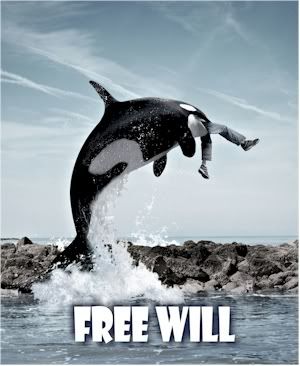
| Free Will. |
God hardened Pharaoh's heart.
After a Hebrew slave had formed a brick - that brick was hardened, either by letting it dry in the sun, or perhaps by firing it in a kiln. The slave dumped a mix of clay and straw into a brick mold and pressed it into the shape of a break - then the "brick" was hardened into that shape forever. Prior to this hardening, the clay was malleable, but once the clay has set (hardened), it stayed in the shape of the brick. That is what it means to be hardened - it means that the brick is in a state whereby it is no longer malleable - no longer able to change.
Likewise, when we say, "let's get to the heart of the matter" - we mean, let's get at the central issue - the core, the very essence of what we are dealing with.
Understanding these concepts, we regard a phrase like God hardening Pharaoh's heart, to mean, not that God had physically vulcanized the blood pump in Pharaoh's chest, but that God was causing Pharaoh to remain in that state of rebellion that Pharaoh had freely chosen to embark upon.
Scripture describes repentance as something that God grants to sinners, which means that in order to repent, God has to intervene in the life of a sinner. That is an important thing to understand, because when we talk about God hardening Pharaoh's heart, it may well mean only that God refused to intervene in the life of Pharaoh; that is, that God decided not to give grace to Pharaoh in causing him to repent. If God refused to cause Pharaoh to repent, and if repentance is something that fallen man is incapable of, as scripture teaches, then the hardening of Pharaoh's heart is nothing more than allowing Pharaoh to continue unchecked, down the road of his own choosing.
Whatever role God played in Pharaoh's hardening, one thing is beyond debate - God's role was active, and it had a purpose.
If we are able to discern that God allowed Pharaoh to continue in rebellion in order that God's purposes were fulfilled, and this is really beyond debate as well, then we are saying that while God does not force a man to rebel against him, God can and does use the rebellion of men to bring about His will.
We see this sort of thing in the crucifixion of our Lord, where Luke tells us in the book of Acts (c.f. Acts 4:27-28), that God had predestined the death of Christ to occur. We do well to cogitate on the question, "How could a good God predestine the most heinous crime that would ever be committed?"
The answer to such riddles lies in separating the big picture from the little picture.
I love my children. It is never my will to see them suffer in pain. Yet when each of my children were babes I gave them into the doctor's hand. She then jabbed an inoculating needle into each of their pudgy little thighs, causing pain to them. Was I lying when I said that it is never my will to see my little ones suffer in pain? No, I was not lying. Yet even though I took no pleasure in their suffering, I allowed it for the greater purpose it served. Likewise, when my little daughter desired to learn to skate, I allowed her to do so, even though I knew that she would eventually, and often, fall on the hard ice whilst learning. Do I desire her pain? No, yet I suffer it in order to allow a greater purpose - her learning to skate.
God took no pleasure in the death of His son, it was not His will that Christ suffered, or that any of us suffers - yet in order to serve a greater purpose, God allowed Christ's suffering.
The same logic helps us understand how it is that even if it is not God's will than any should perish, and that all should come to repentance - yet that is balanced by God's greater purpose which required that God not grant repentance to Pharaoh.
Now you may be asking, what does all this have to do with free will?
I bring up Pharaoh because scripture plainly tells us that God hardened Pharaoh's heart - that is, that God withheld repentance from Pharaoh (God didn't intervene in Pharaoh's life, granting Pharaoh repentance). If God chose not to intervene in Pharaoh's life, and if repentance is, as scripture describes it, something God grants us, and not something that we can just do ourselves, then whatever options were open to Pharaoh - repentance was not one of them.
Pharaoh was free to choose between the red pill and the blue one, because those were his options, God hadn't put the green one on the table. Pharaoh's free will was by no means violated by this limiting of choices. Repentance was not in Pharaoh's nature, any more than it is in my nature or your nature - the option of repentance, for Pharaoh was an intellectual mirage - it was there, but he had no ability within himself to desire it. It was an option only in the sense that he could will his body to behave in a fashion that looked to be in accord with genuine repentance - and in this way he appeared to almost repent several times - but he could not mean it, because it wasn't an option open to a sinner whom God had determined not to grant repentance to.
We are only free to choose from amongst those options available to us. If we insist, contrary to scripture, that we have in us the ability to repent, that is, if we insist that we are by no means in bondage to sin, and therefore morally capable of repentance, we commit a well known heresy: Pelagianism. If we try and water that down, as is vogue today, so that we agree that we are very, very, morally corrupt, but just not completely corrupt, that is, we are pretty much in bondage to sin, but not entirely - and we imagine that there is some sliver of light within us that can repent of its own accord - we still make the same error, even if we try hard to lean away from it with all our might.
The battle for free will, is not really about whether or not we are robots, it is actually about whether or not we are morally capable, for if we -are- morally capable, then we have more options open to us in our decisions. If we are not morally capable, our options are limited. Our freedom to choice doesn't change - but our choices do.
The problem is that many who argue for "free will" imagine that those who oppose them oppose the notion of "free choice" - as if by opposing "free will" we imagined that God was in the business of manipulating the thoughts of men. Has ever a straw man been so puffed up?
I right understanding free will looks like this: We are free to choose anything we want, and God doesn't impose himself upon our intellect to limit it in any way. Yet we are only free to choose those options which are within our nature - and unless God personally intervenes and adds "extra" options (such as repentance), which are entirely alien to our nature - we will by no means choose them.
This granting of repentance as a moral option is called "grace".
Free will is not any less free because of moral inability - all that changes is the number of choices available.Labels: free will |
posted by Daniel @
8:57 AM
1 comment(s)
 
|
|
|
|
| Dehydration and Thirst. |
Two biologists found themselves at odds about their understanding how the whole hydration process.
The first biologist set forth his theory on thirst thus:
Biologist #1: Thirst is a choice made by the body in answer to the reality of dehydration. If the body does not realize it is dehydrated, it does not choose to be thirsty.
The second biologist rejected the first biologist's theory thus:
Biologist #2: Thirst is not a choice made by the body, but is in fact an involuntary reaction to dehydration, such that unless a body is in some way impaired so that it is unable to thirst, it will always thirst whenever it is dehydrated.
The following debate records their interaction with one another on the subject:
Biologist #1: Dear colleague, I appreciate the great love we both share for our present occupation and the science behind it. Yet in fairness to you I see in your opinion some room for instruction, and I hope you will allow me to show you what I believe to be errors in your reasoning - after which, upon seeing your errors, I am sure you will agree with my position.
Biologist #2: My esteemed companion, believe me when I say, I am ready and willing to be instructed out of my error, though I confess, I am blind to any fault in my reasoning. Perhaps you will convince me, but I hope if you fail to do so that I might examine your opinion with a similar scrutiny?
Biologist #1: oh, of course, my good man, of course. Now allow me to begin. You say that thirst in involuntary? Even a child is aware that they can deny their thirst at will, likewise, even a child is able to drink when not thirsty - you need only go to the fair and you will see many young people sipping on carbonated syrup water, not as a result of some involuntary thirst, but rather out of a plain choice to do so.
Likewise you say that unless a body is impaired in some way so that it is unable to thirst, that dehydration will always cause a body to experience thirst. What sort of nonsense is this? And forgive me my incredulity, for you seem such a bright fellow to make such a tragically avoidable error; and yet here it is: I have yet to find even one such person as you portray here - not even one sir - who has even been impaired in the manner that you describe. It is a ghost sir, a non entity, a phantom created by some warped imagination for no other reason than to create some greater link between dehydration and thirst than clearly exists (and again, forgive me my boldness for I am only so bold as I am certain that this monstrosity is by no means your own invention but you likely inherited the idea from some buffoon in your past, and have never sat down to really examine it closely).
My opinion sir, as I am sure you now realize, is quite unassailable, and having shown that thirst is clearly a choice, and furthermore that there is no good reason to believe such an involuntary link exists between dehydration and thirst as you suggest, we are left to conclude sir that thirst is entirely a choice made in response to dehydration - and not caused by it.
On that self evident point sir, I believe my case to be made and so I await your retraction with eager anticipation.
Biologist #2: Thank you again dear sir for your kind tutelage in this matter. I am of course intimidated by your great learning and insight, yet my resolve is to press on - trusting to an equally great humility you no doubt possess amidst your other fine and obvious qualities, I say, I trust that you will bear any folly that might find itself in my opinion.
Allow me to address first the gaping gulf between what I have truly said and what you have heard me to say. I do apologize for failing to communicate my thoughts as I am truly at a loss to explain how far your understanding of my words has strayed from their meaning; yet I accept the blame, and re-double therefore my efforts to be clear and unambiguous in my locution.
First, I believe I should begin by touching upon what we seem to agree upon. Like yourself, I too believe that a person is free to choose to answer or ignore his thirst, and likewise free to drink regardless of thirst. Upon this point there is no disagreement between us.
Where we disagree however is not upon the voluntary nature of choice, for surely choice is by any definition a voluntary thing. You do well to defend that point my friend, though we must caution, that since no one is contending it here, it neither negates my position nor bolsters your own - rather it merely takes up space in our discussion fruitlessly. Let us not babble on about those things that all rational people must agree upon, nor exhume them from whatever graveyard we have buried our own demons, but instead bypass them altogether in favor of those things which are pertinent to our discussion.
I agree therefore that even children can refuse to drink when thirsty, and can drink when they are not thirsty - yet we do not want to confuse our reaction to thirst with the thirst itself. To do so would be to blur apples and oranges together into one fruit. No sir, if we are reacting to an impetus, our reaction cannot be explained as the genesis of the impetus, if you follow me.
It is the same as catching a ball that is thrown to us. We may choose to catch the ball or not, but in determining to catch it, we must not imagine that our choice produced the throw. I hope that is evident.
To your other objection sir: you object to the idea that a physical impairment might dismantle one's ability to thirst based on the fact that you have never seen it happen personally, nor have heard of it happening.
I confess, that while I find you a worldly fellow, I can't be dissuaded from my point based solely on your ability to know a thing, and furthermore to retain in your memory all that you may have known, not withstanding, though this is sufficient to reject your objection, yet I can plainly give you examples that I am sure you will agree exist.
There was just last week a carriage accident, where a fine young lady took a spill and conked her brow on the curbstone sending her these three days into a state of unconsciousness. You will note that her nurses have been diligent in putting wet clothes to her mouth and allowing her to take in some hydration to avoid the dehydration. Might I draw your attention to this sir, clearly unless one is conscious to experience the sensation of thirst, one is impaired in one's ability to respond to it.
Which is to say, your objections seem to be so many empty or misdirected words. I do hope you will not object to my saying so, but will correct them where they are erroneous, or where my understanding of them has failed.
Likewise sir, I should like to state precisely my estimate of your own position, do bear with me.
Your suggestion that the body makes a choice to be thirsty, seems to be a confusion between the body and the mind - for it is the mind that makes choices and not the body, for as I have noted, it is quite possible for a body to be unconscious and dehydrated in the same moment, but in order to be thirsty one must be sensible.
Given this presumption of confusion on your part, I extend that presumption to the idea of the mind realizing it is thirsty. I agree with you that the mind must realize it is thirst in order to respond to the thirst, but again sir, I do not confuse together into one entity the notion of thirst and dehydration - for the one surely causes the other and is not to be confused with it on that account.
Your opinion sir, if I may restate it is that we "choose" to be thirsty in response to our dehydration, that our thirst is in fact a conscious decision. Here is where you confusion lies sir, and do tell me if I have identified it or nay: Are you not simply confusing the thirsting with the act of drinking? That is, we choose to drink or not to drink in answer to our thirst which we have no conscious control over.
Please let me know if I am confusing or enlightening you - of perhaps if I am sorely mistaken?
Biologist #1: Are you telling me you see a difference between the thirsting and the drinking?
Biologist #2: Yes sir, I am.
Biologist #1: Now hear me out dear sir, clearly the two are one and the same, you must see that.
Biologist #2: Actually, I do not see it. What I see is a choice to respond or not to a stimulus, and not a choice to be stimulated or not.
Biologist #1: Well sir, if you cannot see the truth for what it is, you are beyond my help.
Biologist #2: I am sorry you feel that way.
 This is, of course, representative of the discussion we see again and again concerning the freedom of the will, except that it isn't as pointless, drawn out, full of out of context verses, pride and all round tomfoolery. Well, the tomfoolery might apply, but you get the point... This is, of course, representative of the discussion we see again and again concerning the freedom of the will, except that it isn't as pointless, drawn out, full of out of context verses, pride and all round tomfoolery. Well, the tomfoolery might apply, but you get the point...
The Arminian sees that everyone has a choice to believe the gospel or reject it. No Calvinist would object to that. We all -do- have a choice. Yet Calvinist understands that whatever choice we do have is fenced around by the presence of thirst in our life. Am I thirsty for Christ, or not? If I am not thirsty, I may well make a choice to follow Christ, but my choice will be as vacuous as my thirst, and eventually, the soil into which the gospel seed fell will show itself wanting. Likewise, lacking a thirst I can also choose to ignore the gospel - which is really the default choice. There is freedom to choose.
But my choice does not generate the call, it doesn't generate the thirst. If I am thirsty, I can resist that thirst for a time, but eventually I will give in. That is the nature of thirst. It isn't that I don't have free will, it is that my free will eventually chooses to slake that thirst that I have no control over. Likewise, of course, I can give into the thirst without a struggle, either way, the seed will eventually find good soil.
These things are simple enough I think, yet I still have ample opportunity to see some argue that irresistible grace can only mean robotic mind control. These who have in themselves experienced thirst would never argue that answering their own desire to slake a thirst was some form of mind control - even if the nature they find themselves in possession of (that is, a body that naturally craves water when it is dehydrated) illustrates the point clearly enough - yet still they fail to see the that there is a world of difference between having the freedom to make a choice and being outside of God's sovereign control. God has sovereignly designed us to thirst for water when our fluid levels are insufficient. There is not a man alive who doesn't daily slake that thirst of his own free will - but understand this: God has willed each of us to do that, and provided the way to do that without doing injury to the freedom of our choice.
I want to repeat that in case it was misunderstood.
God ordained that all men everywhere would choose to drink liquids. God doesn't turn them into robots to make them drink liquids, he gives them a thirst, and they choose to drink of their own free will. God's sovereignty does not hijack their free will, but their free will responds to God's sovereign decree. Our God can do that. Our God -does- do that, and if anyone cannot see that, it is because they choose to be blind.Labels: free will |
|
posted by Daniel @
11:46 AM
18 comment(s)
|
|
|
|
|
|

