|
|
| |
 - Endorsed - Endorsed - Indifferent - Indifferent - Contested - Contested
|
| |
| The Nashville Statement
|
| |
|
|
| |
 Name:Daniel
Home: Winnipeg, Manitoba, Canada
About Me: I used to believe that evolution was reasonable, that homosexuality was genetic, and that people became Christians because they couldn't deal with the 'reality' that this life was all there was. I used to believe, that if there was a heaven - I could get there by being good - and I used to think I was more or less a good person. I was wrong on all counts. One day I finally had my eyes opened and I saw that I was not going to go to heaven, but that I was certainly going to suffer the wrath of God for all my sin. I saw myself as a treasonous rebel at heart - I hated God for creating me just to send me to Hell - and I was wretched beyond my own comprehension. Into this spiritual vacuum Jesus Christ came and he opened my understanding - delivering me from God's wrath into God's grace. I was "saved" as an adult, and now my life is hid in Christ. I am by no means sinless, but by God's grace I am a repenting believer - a born again Christian.
My complete profile...
|
| |
Daniel's posts are almost always pastoral and God centered. I appreciate and am challenged by them frequently. He has a great sense of humor as well.
- Marc Heinrich
His posts are either funny or challenging. He is very friendly and nice.
- Rose Cole
[He has] good posts, both the serious like this one, and the humorous like yesterday. [He is] the reason that I have restrained myself from making Canadian jokes in my posts.
- C-Train
This post contains nothing that is of any use to me. What were you thinking? Anyway, it's probably the best I've read all day.
- David Kjos
Daniel, nicely done and much more original than Frank the Turk.
- Jonathan Moorhead
There are some people who are smart, deep, or funny. There are not very many people that are all 3. Daniel is one of those people. His opinion, insight and humor have kept me coming back to his blog since I first visited earlier this year.
- Carla Rolfe
|
| |
|
email
|
|
| My take on Romans 7 |
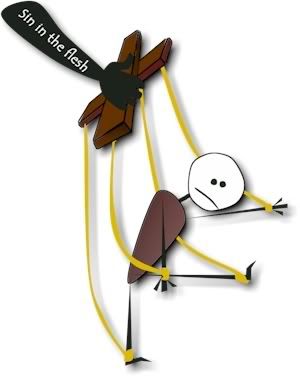 What I want to do, I don't do. What I want to do, I don't do.
What I don't want to do - that is the thing that I do.
Is Paul describing himself or making an illustration in the first person? If he is describing himself, is he describing his former conduct as a Jew, or his current struggle as a mature Christian?
Sincere, godly men disagree on this point, so I expect some of you who read this to sincerely disagree with my understanding of the text - I take that as a given. There is a lot at stake in this passage, and many of us hold our understanding of it quite passionately - and, if I may be so bold, I would say especially those of us who hold that Paul is describing his current state as a believer - since we who see ourselves in the struggle of Romans 7, and know ourselves to be genuine believers - are apt to make conclusions favorable to our own experiences.
Now, as a preamble, allow me to say that I hadn't intended to make a post on Romans 7 per se, but having mentioned Romans seven in the sermon and having discussed it afterwards with Bryan, (who has disagreed with me for a few years now on our various interpretations on this passage, and having read this post over at Bryan's blog, I thought, and having started to reply to his post over at his blog and finding my response too verbose for a casual comment - I thought it best to reply here on my own blog - and link to it from there. What you see therefore is my reply to Bryan, and subsequently, my understanding of the text in question.
Now, before we continue, I should add that I know all about the "present tense" of Paul's discourse, and while we use the present tense to describe things that are presently true, we also use the present tense linguistically when presenting hypotheticals - so I am not shaken by nor overlooking Paul's use of the present tense in this passage, I am merely regarding it as an hypothetical illustration rather than an autobiographical aside.
My understanding of this portion of Romans 7 is not that it does not describe a "Christian" - but rather that it describes a person who is not experiencing victory over sin by walking in the spirit - it depicts what walking in the flesh looks like.
Paul has just spent the previous chapter saying that we (those who are in Christ) shall not continue in sin - that is, that we shall no longer be in this kind of Romans 7 bondage, because we died with Christ and in doing so we died to our previous bondage.
Let's be honest - anyone can suppress sin in their own strength - in fact, that is what every other moral scheme and world religion is founded on. But the death described in Romans 6 provides the only power in creation to spiritually deal with sin - only this power operates through a very specific, and counter-intuitive means: faith. It manifests itself after one begins trusting that one is in fact dead to sin and alive to God (literally) in Christ Jesus - and after one begins putting all their trust in the fact that it is going to be =this= union with Christ in death that frees an individual from sin's dominion, and that carnal, external obedience (suppressionism) having no power to free you from sin's bondage, will simply save you from expressing the sin within in the moment, and do nothing to deal with the sin within that is producing this stuff.
That is not to say that you sit around and meditate and sin goes away - nor is it to say that you simply auto-suggest your sin's away by suppressing with a better, more spiritual cork. The plain truth is that there is -no- substitute for faith. You can go through the motions, but if you do not really believe that you are dead to sin because Jesus made you dead to sin, you will be in Romans 7 throughout all your effort. =THAT= is what Romans 7 is describing - a struggle to obey God without the power to do so - that is, a struggle in the flesh. Anything that is not of faith is by default of the flesh - no matter how righteous it might look on the outside.
Paul himself explains what Romans 7 is describing, he does so in Romans 7:21-23 "So I find it to be a law that when I want to do right, evil lies close at hand. For I delight in the law of God, in my inner being, but I see in my members another law waging war against the law of my mind and making me captive to the law of sin that dwells in my members. "
Romans 7 describes the law of sin that was "bring[ing] death to [him]"
But Paul does not cave in there and say that we remain in bondage to this law of sin in our members that is producing death in us. He immediately comes to the solution for which he bothered with the parenthetical illustration in the first place. In 7:24 he asks,"...Who will deliver me from this body of death? " he labels the experience he has just described - not as "the normative Christian experience" but as "the body of death" - referring to the fact that this body is controlled by a law of sin that produces death. His question underscores the fact that he is in the middle of teaching a deliverance from the bondage to this law of sin and death that was started in Romans six - this was no autobiographical aside, this was a practical exposition of what Paul means when he says "the law of sin and death" - for when Romans 8:2 tells us that the Spirit of life in Christ Jesus sets us free from the law of sin and death - we need to know up front what the law of sin and death -is-.
The law of sin and death is that law that is in our members that makes us obey sin - that is what Paul was describing - he begins it in Romans six in summary form: "Sin shall no longer have dominion over you because you are no longer under law but under grace" - as soon as he gives this summary he starts qualifying it because if he doesn't one might imagine that the moment you become a Christian you magically stop sinning. His reponse therefore to the idea that this grace from God allows you to continue in sin is to say, "By no means!" - but he then begins to show that even when you are not a legitimate slave, yet if you present yourselves to a master and obey him, you are (for all intents and purposes) that one's slave whom you obey. In other words even if you have been set free, if you continue to obey your old master, you are are still in bondage - even though you don't have to be. Paul sums up his thoughts there by thanking God that we have been set free from sin by becoming slaves of righteousness, and in doing so he gives us a crucial part of the deliverance plan - you are either obedient to Christ, or you are enslaved to sin - there is no middle ground.
When Paul begins Romans 7 with the question - "do you not know?" he is introducing an expository discourse - arguing from the lesser to the greater - he wants to show to the Jewish mindset that what he is teaching is not contrary to the way in which God's covenant works - by showing that just as the law of marriage binds the wife to her husband while he yet lives, and is no longer binding after the life that held her in bondage (her husband's) is dead, so too when we died in Christ we were set free from something in us that was "aroused by the law" and "at work in our members bearing fruit for death" - but up until this point "that something" that we have been set free from (just as the widow was set free) has yet to be given a label.
This is the context in which Paul begins the discourse in question - after he boldly says that we have been released from the law (that aroused sin in us) having died to that which held us - he then begins to illustrate the very thing we have been set free from - that is, he begins to illustrate how the law does not deliver a person out of bondage to sin - for the one who has the law and tries to obey the law finds that the law has no power against sin - it only demonstrates that he is a sinner because it shows him what is wrong, and he finds himself unable to resist doing what is wrong even though he has the law to tell him that it is wrong. The law in no way empowers him to do what he wants to do (obey the law) and does nothing to deliver him from doing what he does not what to do (disobey the law).
Paul is showing that there is something that the law can not do in that it is powerless to deal with the corruption we inherited from Adam - the "sin" that remains in our flesh.
He is bringing us through this illustration so that when he again states that we are saved from this in Christ, we know what we are saved from.
In Romans six Paul teaches:
[1] that God delivered us from sin in Christ, and
[2] this deliverance is bound up in our union with Christ, that Christ's death on the cross, our union with Him, and God raising us up in Christ is the means by which (through faith) God does in us what the law wasn't able to do - deliver us from sin's power.
This deliverance is brought about by our death in Christ, for that death delivered us from our former bondage - In Romans 7 Paul shows that the way this death delivers us from bondage is not contrary to God's ways, but in fact complementary - for just as the bride is bound to the law so long as that which binds her lives, so too we are bound to law that governs our "flesh" for only as long as the "flesh" lives. He then contrasts this great deliverance with the very bondage one is being delivered from (which is, of course, what is being described in the passage in question) - he contrasts it with the law of sin and death so that when he concludes the description of the law of sin and death, his proclaimation that you are free from that "law of sin and death" has tangible context.
The struggle in Romans seven is not an autobiographical description of Paul's "current" struggle with sin - it is the logical and necessary continuation of a point he began to make in Romans 6 - an illustration of what "the law could not do" an illustration that gives substance to his conclusion: that the Spirit of life has set us free from something in Christ - it sets us free from the law of sin and death - that is, it sets us free from "Romans 7."
I agree therefore with the Piper quote this far: Paul is not teaching that we should make peace with sin - though I would say that Chapter six teaches that we have already won the war against sin (in Christ), as opposed to "will win the war" - but I would word it in such a way that there is no room to use Chapter seven to excuse "tactical defeat" in the battle against sin, and I would be careful to show that tactical defeat was not a necessary, or normative component of the process. I would say chapter 7 illustrates the law of sin and death that Christ delivered us from in Himself, and that the struggle described there is nothing more than the default, carnal approach to trying to obey God when we are doing so in a spiritual vacuum; even if this is our default approach the moment we come to Christ, and I would add, even the default fall back position that we immediately assume the very moment we neglect to walk in faith, or said another way, the moment we fail to walk in the Spirit. When we walk in the spirit we do =not= give into the flesh.
Piper's concluding remark was:
It's the earnestness of the war and the response to defeat that show your Christianity, not perfection.
I don't pretend to correct Piper, but for the sake of this discussion, I would elaborate on that conclusion thus:
The earnestness of our war is demonstrated by our unwillingness to continue to walk (by default) in the flesh. The Christian who is ignorant of the doctrine of deliverance nevertheless abhors in himself this carnal walk even if he cannot describe it in theological terms. This desire to be free from a carnal walk does not originate in his flesh, but is the divine character of the Holy Spirit within him. This abhorrence for sin shows that the Holy Spirit is within him and that he is a genuine child of God, but until he begins to deal with sin spiritually in Christ, that is, according to the only provision God has made - he remains carnal and impotent; though in truth he has been set free from sin's power, that freedom is only in Christ, that is, it is only appropriated his when he walks in Christ by a determined and willful act of faith. The consistency of his walk in Christ (and consequently, his deliverance from sin) reflects his spiritual maturity. Spiritual maturity is not a measure of how regenerate you are, it is a measure of how Christ-like you are. When you are in the Spirit you are perfectly Christ-like, and when you are not in the spirit, you are carnal and not Christ-like at all - even if in the strength of your flesh you manage to near-perfectly approximate the character of Christ (through habitual suppression of sin, forming sin breaking habits, and doing good deeds even though your heart is secretly not in it) - yet this asceticism has absolutely no power, and is a mark of immaturity as surely as wanton sin is. An unsaved person can be quite earnest in the war against sin (how many orthodox Jews do we need to know before we understand this?), but his earnestness doesn't suggest he is a Christian - it only shows he is earnest.
The Romans 7 struggle depicts a man trying to obey through means other than grace. That could be a Jew, or it could be a theologically confused believer - it doesn't matter who it is, what matters is that in your flesh the law of sin and death reigns until you stop obeying it - and you cannot stop obeying it except through faith - through reckoning yourself dead to sin and alive to God in Christ - it is a faith thing, not a grit your teeth and obey thing.
Trying to obey the law is good for you - especially if you are earnest and zealous - because it will wears you out faster - because nothing brings you to Christ faster than trying to keep law and failing miserably because you are unable to do so.
Let me know if that explains it or not.Labels: Q and A, Romans, sanctification, Theology, union with christ |
posted by Daniel @
10:07 AM
6 comment(s)
 
|
|
|
|
| On Revelation 22:19 |
 and if anyone takes away from the words of the book of this prophecy, God will take away his share in the tree of life and in the holy city, which are described in this book. Revelation 22:19 [ESV] Clearly this text =must= prove that you can lose your salvation ...right?
I mean, the wording here seems inescapable! How can God take away your share in the tree of life, and in the holy city unless you have a share to be taken away?
Is this verse the nail in the coffin of eternal security? I don't think so.
The language is pretty specific, but no more specific than what we read Christ saying in Luke 8:Take care then how you hear, for to the one who has, more will be given, and from the one who has not, even what he thinks that he has will be taken away." - Luke 8:18 [ESV] When we read the alternative accounts of this passage in Matthew 25:29 and Mark 4:25 we see that they do not add the telling "what he thinks that he has" in describing what is taken away. Matthew and Mark simply say that what he has will be taken away. Now, perhaps Matthew and Mark were just careless, or maybe they really didn't agree with Luke, or maybe Luke simply was guessing - but, because I believe God is in control, I am convinced that they meant the same thing Luke did, but didn't think the distinction was all that important to make.
So did these men actually possess a share?
I don't think so.
John makes it plain, the gnostics started out as "Christians" but began to add to God's word things that were not there, and to take away the truth that was there in order to do it. In doing so they went out from orthodoxy and into apostasy demonstrating that they were never genuine in the first place.
So in the one sense, these "branches" that once seemed to be grafted into the vine showed themselves to be bearing the wrong kind of fruit, and because they were they were cast out of the vine - not because they were once genuine and then became disingenuine - but because they were not genuine, and had never truly been genuine. They demonstrated the false nature of their faith by the fruit they produced.
If anyone adds lies to God's word, and removes truth from it - being a pastor, or a church member isn't going to save them on Judgment day - because on that day the counterfeit nature of their faith will be manifest to all. What they seemed to possess (eternal life) will be "taken away from them" - at least, that is how it will seem to them.
Also just an aside. Here is the real global warming story.Labels: Q and A, soteriology |
|
posted by Daniel @
2:56 PM
2 comment(s)
|
|
|
|
|
|

